
Window Furnishings Canberra: 5 Smart Ways to Combine Curtains, Blinds & Flyscreens
A beautiful window can completely change how a room feels. It brings in natural light, connects your home to the outdoors and creates a sense of openness. But in everyday life, one window often needs to do several things. You might love having sunlight in your living room during the day, yet want greater privacy when the lights come on at night. Your bedroom might need soft morning light and stronger darkness for sleeping. Or perhaps you want to leave the balcony door open on a pleasant...
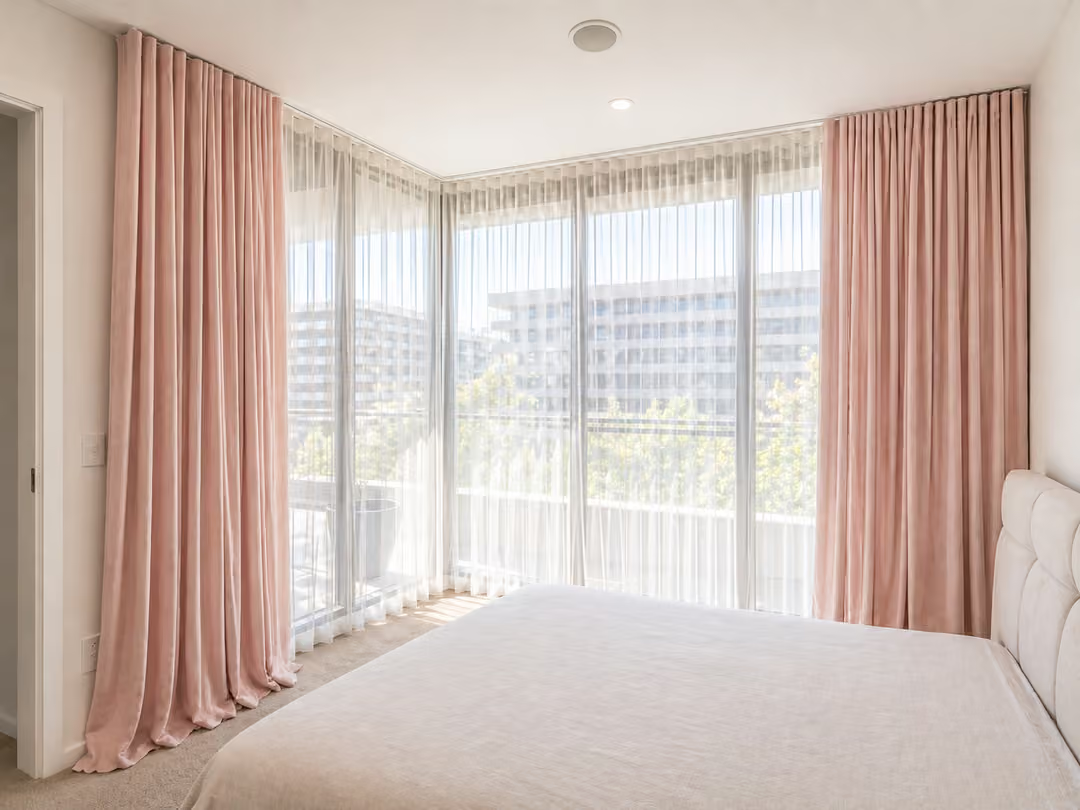
A beautiful window can completely change how a room feels. It brings in natural light, connects your home to the outdoors and creates a sense of openness.
But in everyday life, one window often needs to do several things.
You might love having sunlight in your living room during the day, yet want greater privacy when the lights come on at night. Your bedroom might need soft morning light and stronger darkness for sleeping. Or perhaps you want to leave the balcony door open on a pleasant Canberra evening without inviting insects inside.
That's where thoughtfully combined window furnishings can make a difference.
Rather than expecting one blind or curtain to solve every problem, you can combine products that serve different purposes.
A sheer curtain might soften daylight. A blockout curtain can provide stronger privacy and room darkening. A roller blind may offer compact light control, while a retractable flyscreen helps prevent insects entering when a window or door is open.
The key is ensuring these treatments work together—both visually and practically.
In this guide, we explore five useful window furnishing combinations for Canberra homes, how to plan their installation, what to consider for different seasons, and when a simpler solution might actually be better.
Why Combine Window Furnishings Instead of Choosing Just One?
Not every window needs multiple coverings.
A compact kitchen window may work perfectly well with a single roller blind. A bathroom might need one moisture-suitable privacy treatment. A small bedroom may not have space for generous curtain stacks.
However, layering can become useful when the window has several different jobs throughout the day.
For example, imagine a living room with large glass doors opening to a courtyard.
During the morning, you want the room to feel bright and open.
In the afternoon, you want to reduce glare.
In the evening, you want privacy from neighbouring properties.
And when the weather is pleasant, you'd like to leave the door open for ventilation without letting insects into the home.
No single product necessarily addresses all these requirements equally well.
What does each window furnishing do?
Window furnishing | Main purpose | What it does not automatically provide |
Sheer curtains | Diffuse daylight and add visual softness | Reliable night-time privacy or strong room darkening |
Blockout curtains | Stronger darkness and privacy | Complete darkness regardless of installation gaps |
Sunscreen roller blinds | Reduce glare while potentially retaining views | Reliable privacy after dark |
Honeycomb blinds | Compact light control with cellular construction | A replacement for efficient glazing or draught sealing |
Venetian blinds | Redirect light with adjustable slats | Complete darkness or uninterrupted coverage |
Retractable flyscreens | Help prevent insects entering through open doors and windows | Security-rated protection or temperature control |
Veri Shades | Adjustable fabric folds combining curtain-like appearance with blind-like control | Guaranteed blockout or insect screening |
The right solution starts with understanding what each layer needs to accomplish.
If you're still deciding which type of blind suits your rooms, see our Blinds Canberra: How to Choose the Right Style for Every Room guide.
If you've already identified your preferred products, the next question is how to combine them effectively.
Five Smart Window Furnishing Combinations for Canberra Homes
These five arrangements offer different ways to balance daylight, privacy, room comfort and everyday convenience.
They are examples rather than universal recommendations. The final choice depends on your window size, mounting space, operating requirements and the available products.
Combination 1: Sheer Curtains + Blockout Curtains
Best for: Bedrooms, living rooms and apartments where daytime brightness and night-time privacy are both important.
This is one of the most flexible curtain combinations.
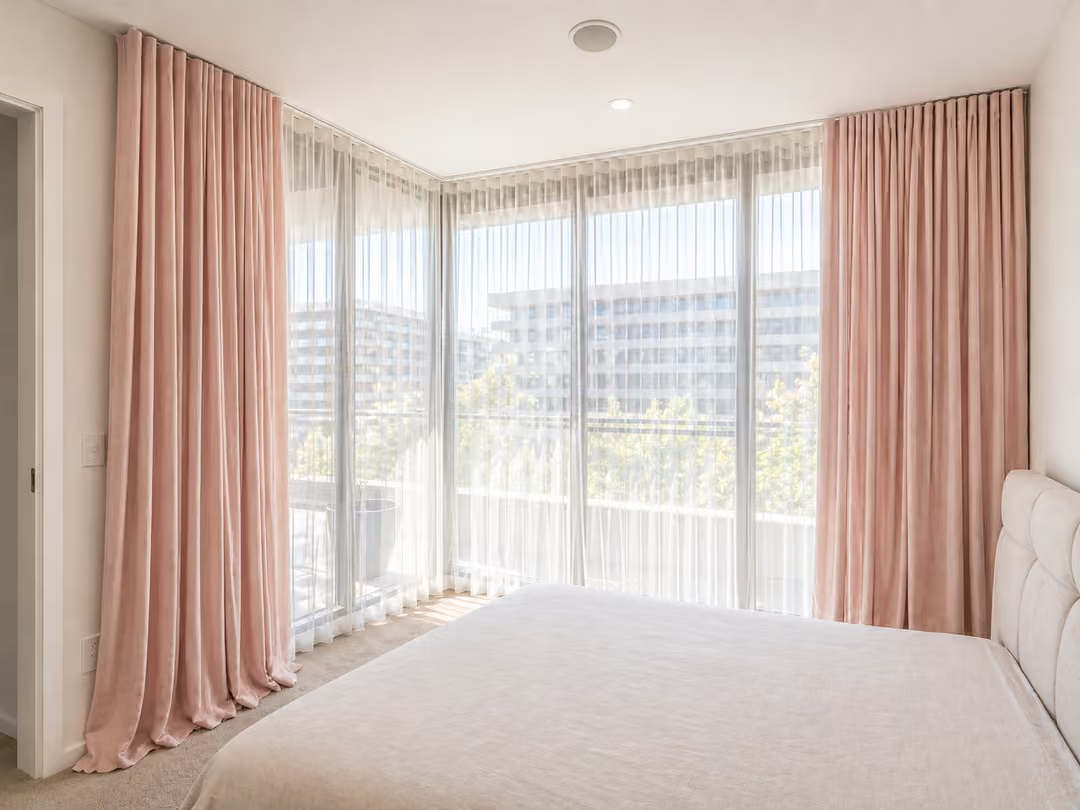
Sheer curtains create a soft, filtered quality of daylight while allowing a room to maintain an open appearance.
Blockout curtains provide a more opaque layer for stronger privacy and darkness when needed.
When installed on suitable separate tracks, the two curtains can be operated independently.
How might you use them?
During the day: Keep the sheer curtains closed to soften bright daylight while allowing the room to remain naturally lit.
In the evening: Close the blockout curtains when privacy becomes more important.
At bedtime: Use the blockout layer to reduce incoming light, particularly in bedrooms facing streetlights or early morning sunlight.
What makes this combination effective?
The two fabrics do different jobs.
Sheers maintain the soft appearance of an interior during the day. Blockouts provide stronger coverage when natural light and outside views are no longer priorities.
However, the installation needs careful planning.
Each curtain requires enough space to move along its own track. The fabric must also have sufficient room to gather when opened, particularly if the windows are wide.
Blockout material itself stops light passing through the fabric, but small gaps around the track, sides or bottom may still admit light.
Real Canberra example: Eastbourne Apartment
At the Eastbourne Apartment, Sweet Home Blinds installed S-wave sheer and blockout curtains as a coordinated dual-layer solution.
The project demonstrates how two curtain layers can create different levels of light control while maintaining a consistent appearance across apartment windows.
If you're considering this arrangement, ask about curtain fullness, track separation, stacking space and the position of any nearby furniture.
Combination 2: Sunscreen Roller Blinds + Opaque Curtains
Best for: Bright living rooms, street-facing windows and home offices where you want daylight during the day but privacy after dark.
Sunscreen roller blinds can be a useful starting point when a room receives strong sunlight but you don't want to close it off completely.
Depending on the chosen fabric, a sunscreen roller blind can reduce glare while preserving some visibility outside.
This makes it worth considering for living areas with garden views or home offices with bright windows.
However, sunscreen fabrics have an important limitation.
When the interior is brightly lit and the outside is dark, people outdoors may be able to see through the fabric more easily.
Pairing a sunscreen blind with a suitable opaque curtain provides another level of privacy.
How does the combination work?
The roller blind sits close to the window and can be lowered when sunlight becomes uncomfortable.
The curtain travels across the wider opening and can be closed when stronger privacy is required.
This arrangement may also suit homeowners who like the practical simplicity of roller blinds but want curtains to add texture and softness to the room.
What should you check?
The curtain needs enough projection from the wall to hang freely in front of the roller blind's brackets and mechanism.
The roller blind must remain accessible and operate smoothly without catching on the curtain fabric.
You should also consider how the curtain will stack when open, particularly if a sofa or television unit sits close to the window.
For rooms specifically affected by low-angle sunlight, see our guide to reducing afternoon sun and glare in Canberra homes.
Combination 3: Honeycomb Blinds + Sheer or Blockout Curtains
Best for: Living rooms, bedrooms and townhouses where homeowners want compact blind operation with the softer appearance of curtains.
Honeycomb blinds have a cellular fabric structure that creates pockets of air within the blind.
Depending on the construction and installation, these pockets can help reduce heat movement around the window.
Honeycomb blinds are also relatively compact, making them suitable for situations where homeowners want the main light-control product close to the glazing.
Curtains can then provide another layer outside the blind.
Honeycomb blinds with sheers
This combination can suit living rooms where softly filtered daylight is a priority.
The sheer curtain creates a continuous fabric finish, while the honeycomb blind can be adjusted independently when greater light or privacy control is required.
Honeycomb blinds with blockout curtains
This arrangement may suit bedrooms where stronger evening privacy and room darkening are priorities.
The blind covers the main window area, while the curtain can extend beyond the frame to provide wider coverage.
However, two opaque layers are not always necessary. The value depends on the room, the selected blind fabric and the desired result.
Can you use all three layers together?
In some homes, yes.
A honeycomb blind can be combined with both sheer and blockout curtains where the installation space and operating systems permit.
But three layers require more mounting depth, separate curtain tracks and enough room for the fabric folds.
A simple two-layer arrangement may be more practical in a smaller room.
Real Canberra example: Denman Terrace
The Denman Terrace townhouse included honeycomb blinds alongside sheer and blockout curtains.
The different products provided separate functions within a coordinated interior scheme.
For a more detailed explanation, read Can Honeycomb Blinds Be Combined With Curtains? A Canberra Layering Guide.
This is a useful example of why a whole-home design doesn't have to use exactly the same treatment at every window.
Combination 4: Flyscreens + Sheer or Blockout Curtains
Best for: Bedrooms, living rooms and balcony doors where homeowners want both insect protection and indoor light/privacy control.
Flyscreens and curtains serve different purposes.
A flyscreen allows an appropriate window or door opening to be used for ventilation while helping prevent insects from entering.
Curtains control daylight, privacy and the appearance of the room.
Combining them can make sense where homeowners regularly open windows or doors.
How would this work in a bedroom?
On a suitable evening, you might open the window and use its flyscreen to help keep insects outside.
An interior sheer curtain could soften the appearance of the room while allowing some air movement, although the fabric position can influence airflow.
When stronger privacy or darkness is needed, you could close an opaque curtain layer.
This arrangement allows each product to do its own job.
What about sliding balcony doors?
A retractable flyscreen can be a practical option where homeowners want insect protection without a permanently visible mesh panel across the entire opening.
However, compatibility must be assessed before installation.
The retractable screen requires space for its housing, guides or track arrangement.
Curtains also need room to move and stack without obstructing the active doorway.
Check the position of handles, door frames, thresholds and nearby furniture before choosing either system.
Important: An ordinary insect flyscreen should not be presented as a security screen. Security performance requires products specifically designed and tested for that purpose.
Also remember that screens do not cool a room by themselves. Ventilation is beneficial only when the outdoor conditions and airflow make it useful.
Combination 5: Retractable Flyscreens + Veri Shades
Best for: Large sliding doors, balconies and frequently used indoor-outdoor openings.
Some openings need two types of functionality without creating too much visual bulk.
A retractable flyscreen can help keep insects outside when the door is open.
Veri Shades combine soft fabric folds with adjustable light and privacy control.
Unlike conventional continuous sheer curtains, Veri Shades use individual fabric vanes that can be adjusted to different positions.
This can make them useful across wide openings where people frequently move between indoor and outdoor spaces.
Why might this work well?
The screen serves the opening when ventilation and insect protection are priorities.
Veri Shades provide adjustable interior light and privacy control while adding a softer fabric appearance.
When arranged correctly, the products can operate separately.
However, installing both systems requires attention to the available space.
The flyscreen housing, Veri Shades track, fabric stack and active sliding-door panel must not interfere with one another.
The arrangement also needs to suit the dimensions and operating limits of the selected products.
For a closer comparison of Veri Shades and conventional sheers, read Sheer Curtains vs Veri Shades: Which Is Better for Canberra Living Areas?.
Which Combination Is Right for Your Room?
The best combination depends less on the number of products and more on how you want to use the room.
Room or situation | Main requirement | Combination worth considering |
Living room | Natural daylight and evening privacy | Sunscreen roller blinds + opaque curtains |
Bedroom | Daytime softness and room darkening | Sheer curtains + blockout curtains |
Townhouse living area | Adjustable light and comfort | Honeycomb blinds + sheers |
Bedroom near an opening window | Insect protection and light control | Flyscreen + suitable curtains |
Balcony sliding door | Access, ventilation and privacy | Retractable flyscreen + compatible Veri Shades |
Home office | Flexible daylight and screen glare control | Sunscreen or adjustable blinds, with curtains if additional privacy is needed |
Small or shallow window recess | Simple operation and minimal space | A single suitably selected blind may be better |
One of the most important design decisions is recognising when not to add another layer.
If one well-fitted blind already provides the function you need, installing an additional curtain may add cost and maintenance without a meaningful benefit.
Installation Planning: Will Blinds, Curtains and Screens Actually Fit Together?
This is where many window furnishing decisions become more complicated.
Two products may look compatible in photographs but require different fixing positions, operating clearances or stacking space.
Before choosing multiple treatments, consider the complete window or door assembly.
Check the available mounting depth
A blind installed inside the window recess requires enough depth for its brackets and operating components.
If curtains are also being installed, their track needs to sit far enough away from the blind for the fabric to move freely.
A shallow recess may require the blind to be face-mounted or the curtain track to be positioned differently.
Allow enough curtain stacking space
Curtains don't disappear when opened.
They gather at one or both sides of the window, forming what installers call the curtain stack.
The required space depends on the fabric, heading style, fullness, track system and total opening width.
If the stack covers too much glass, the room can lose daylight and part of its view.
For sliding doors, the stack should also avoid obstructing the section used for entry and exit.
Our detailed article, How Much Curtain Stack Space Do Canberra Apartments Need?, explains how fabric and track choices affect this important detail.
Think about curtain track separation
When two curtain layers are installed, each generally needs its own suitable track or a compatible dual-track system.
The tracks need enough separation to prevent the fabrics rubbing or catching.
This is particularly important when combining lightweight sheers with heavier lined blockout curtains.
The final separation should follow the selected system's installation specifications rather than a universal measurement.
Check window and door handles
Window handles, sliding-door locks and flyscreen components can interfere with blinds and curtains if they are not considered during measurement.
Make sure the complete window or door can still be operated safely after the furnishings are installed.
Decide which direction the curtains should open
Centre-opening curtains gather on both sides.
Single-draw curtains gather mainly on one side.
For a wide balcony door, the correct stacking direction can make daily access much more convenient.
Consider where people walk, how the door opens and how much clear wall space is available.
Plan motorisation before finalising tracks
If motorised blinds or curtains are being considered, confirm the power requirements and compatibility before installation.
Some systems use rechargeable batteries, while others may require appropriate electrical provisions.
Not every existing manual system can be motorised without replacing parts.
A suitable motorised product can provide convenience, but adding automation later may be more complicated than considering it during the initial design.
How to Use Layered Window Furnishings Through Canberra's Seasons
Canberra's changing seasons make adjustable window treatments particularly useful.
A combination that works beautifully on a bright summer afternoon may need to operate differently during winter.
Summer: Manage unwanted sunlight
During hotter periods, suitable window coverings can help reduce direct sunlight and glare.
A west-facing living room may need its sunscreen blind lowered before the strongest afternoon sun arrives.
However, internal blinds are not a complete substitute for external solar shading.
The Australian Government's YourHome shading guidance explains why window orientation and shading design matter, particularly for east- and west-facing glazing.
Winter: Make use of beneficial sunlight
During colder months, natural solar warmth can be welcome.
A north-facing living room may benefit from opening suitable coverings when sunlight reaches the windows.
Later, closing well-fitted coverings can help improve comfort around cold glazing.
The Australian Government's energy.gov.au window guidance recommends adjusting window coverings according to the season and using suitable close-fitting blinds or curtains to help manage heat transfer.
Actual results depend on the window, material, fit and how the products are used.
Spring and autumn: Adjust throughout the day
Milder weather often brings opportunities for natural ventilation.
Where outdoor conditions are suitable, opening a screened window or door can allow fresh air through while helping keep insects outside.
Sheer curtains may create a softer appearance when the room is open to daylight.
When the temperature falls or privacy becomes more important, the opaque layer can be closed.
A practical day-to-night routine
Time or condition | Possible window furnishing setting |
Bright morning | Open or partially close sheers according to daylight and privacy |
Strong afternoon sun | Lower sunscreen blind or adjust suitable shading |
Pleasant outdoor conditions | Open suitable screened windows or doors for ventilation |
Evening with lights on | Close opaque curtains or privacy blinds |
Cold winter night | Close suitable well-fitted coverings to help improve comfort near windows |
The important point is flexibility, not keeping every layer closed at the same time.
Daytime Privacy Is Different from Night-Time Privacy
Privacy is one of the most common reasons homeowners consider layered window furnishings.
However, fabric opacity is often misunderstood.
During the day, sheer curtains can make it more difficult to see clearly into a room when outside light is stronger than indoor light.
The same effect may occur with some sunscreen blinds.
But the relationship changes after sunset.
When the interior is brightly lit and the outside is dark, people may be able to see through lightweight fabrics much more easily.
This is why a sheer curtain or sunscreen blind should not automatically be treated as complete privacy protection.
For a street-facing living room or overlooked apartment, an appropriate opaque layer may be important.
Before choosing the final combination, consider how the fabrics behave under both daytime and night-time lighting.
Creating a Cohesive Look Without Making Windows Feel Too Busy
Combining several window treatments shouldn't mean adding unnecessary visual clutter.
The most attractive schemes usually have a clear relationship between fabrics, hardware, colour and scale.
Choose a consistent colour direction
Neutral sheers can work with many interior palettes, while opaque curtains provide an opportunity to introduce a warmer or stronger tone.
Consider how the fabric colours relate to the walls, flooring and existing furniture.
You don't need every curtain and blind to match exactly.
Complementary colours often create a more natural result than using identical fabric everywhere.
Balance texture with simplicity
A softly textured sheer curtain may work well with a simple roller or honeycomb blind.
If the curtains already have prominent folds and a decorative finish, the blind can remain visually restrained.
This allows one product to provide the main decorative element while the other performs a more functional role.
Coordinate the hardware
Tracks, brackets, exposed rails and operating components contribute to the finished appearance.
Where multiple treatments share a window, consistent hardware finishes can help create a cleaner result.
However, appearance should not take priority over safe fixing, mechanical compatibility or access.
Think about how the products look when open
Most product photographs show blinds or curtains in a carefully arranged position.
In everyday use, curtains may be gathered at the sides while blinds are raised.
Consider the complete appearance in both open and closed positions.
For wide windows, the curtain stack may be a prominent feature even during the day.
Real Canberra Projects: Layering in Practice
Actual installations provide a useful way to understand how different window furnishings can be combined.
They also show why the best arrangement depends on the property rather than a fixed design formula.
Denman Terrace — Honeycomb blinds with curtains
The Denman Terrace townhouse used honeycomb blinds together with sheer and blockout curtains.
The honeycomb blinds provided a compact window treatment, while the curtains added different levels of fabric coverage and visual softness.
The project demonstrates that a coordinated home can use several window furnishing systems without expecting every window to have the same arrangement.
Eastbourne Apartment — Sheer and blockout curtain layers
At Eastbourne Apartment, S-wave sheer curtains were combined with blockout curtains.
The two layers provided different light and privacy settings within a consistent curtain design.
This arrangement also highlights why track placement and fabric stacking should be planned as part of the original installation.
Deakin Apartment — Sheers with motorised blockout roller blinds
The Deakin Apartment installation provides another approach: motorised blockout roller blinds paired with sheer curtains.
Instead of using two full curtain layers, the blockout treatment sits closer to the window, while the sheers provide a softer visual finish.
This is a useful example of how different products can fulfil complementary roles.
The best installation for your home depends on the available space and the functions you want each window furnishing to perform.
When Is Layering Unnecessary?
More products do not automatically mean a better result.
Some windows work best with one carefully chosen blind or curtain.
For example, a kitchen may need a practical covering that is straightforward to clean.
A narrow bedroom recess may not have enough room for a blind and multiple curtain tracks.
A sliding door with little surrounding wall space may require a more compact solution.
You may not need multiple layers when:
One product already meets the light and privacy requirements.
The available space is limited.
Extra tracks would obstruct door or window operation.
The window is rarely used or adjusted.
Maintenance needs to remain simple.
The additional layer would not deliver a meaningful improvement.
A thoughtful window furnishing plan should explain why each product is needed.
If you are only choosing a single blind, our room-by-room blinds guide is a useful starting point.
What Affects the Cost of Layered Window Furnishings?
The total cost of a layered arrangement depends on several practical factors.
The number of products is important, but so are the dimensions, materials and installation conditions.
Factor | Why it affects the quote |
Window or door dimensions | Larger openings require more material and may need different systems |
Number of layers | Additional blinds, tracks, curtains or screens add components |
Fabric selection | Materials, linings and finishes affect manufacturing requirements |
Curtain heading and fullness | Influence fabric quantity, track specification and stack |
Mounting and fixing | Some openings require more complex brackets or suitable substrates |
Retractable screen system | Housing, track, mesh and opening dimensions affect the specification |
Motorisation | Adds compatible motors, controls and possibly electrical requirements |
Installation complexity | Access, obstructions and existing fittings may affect labour |
Rather than choosing the maximum number of layers, begin by defining the required functions.
For example, if you want natural daylight and night-time privacy, you may only need two complementary products.
If you also want insect protection through an opening door, a suitable flyscreen may be a separate requirement.
The right solution should be based on the individual window and the way your household uses it.
For a more accurate assessment, request a free measure and quote from Sweet Home Blinds.
Important Safety and Maintenance Considerations
Practicality doesn't end when the products are installed.
Layered treatments need to remain safe, accessible and manageable over time.
Child safety
Loose or looped operating cords can pose serious risks to young children.
Australia has mandatory requirements for certain corded internal window coverings and their installation.
When choosing a system, consider appropriate cordless, wand-operated or motorised options where suitable.
Always check the completed installation and keep hazardous cords away from children and climbable furniture.
For further information, see the ACCC's blinds, curtains and window fittings safety guide.
Curtain maintenance
Sheer curtains and blockout curtains may have different cleaning requirements.
Some fabrics can be gently maintained with regular vacuuming, while others need specialist cleaning or particular washing instructions.
Always follow the care guidance provided for the exact fabric and lining.
Blind maintenance
Roller and honeycomb blinds also require appropriate care.
Dust can accumulate around the fabric, hardware and upper mechanisms.
Avoid applying excessive water or aggressive cleaning chemicals to materials that are not designed for them.
Flyscreen maintenance
Flyscreens may collect dust, pollen and debris.
Keep tracks and operating components clear, and follow the manufacturer's cleaning instructions for the mesh and housing.
For retractable systems, check that the screen moves smoothly and retracts properly before use.
Your Window Furnishing Planning Checklist
Before booking a consultation, take a few minutes to record what each window needs to do.
Start with function. Is your main priority glare reduction, privacy, room darkening, thermal comfort, insect protection or a combination?
Think about the time of day. Do you need different levels of coverage in the morning, afternoon and evening?
Consider how the window operates. Does it slide, swing, tilt or open inward? Are there handles or locks that must remain accessible?
Look at the available space. Is there enough room for multiple tracks, blind brackets and curtain stacks?
Photograph the area. Include the full window or door, nearby walls, furniture, ceiling and any existing fittings.
Plan your preferred finish. Think about fabric colours, heading styles and visible hardware.
Ask about maintenance and safety. Consider who will operate the products and whether the controls suit the household.
Set your priorities. Identify which features are essential and which are optional before requesting a quote.
You do not need to know the final combination before arranging a consultation. A suitable measurement and product discussion can help determine which systems will work together.
Frequently Asked Questions
Can you install blinds and curtains on the same window?
Yes, many windows can accommodate both blinds and curtains. The available mounting space, brackets, curtain track projection and operating clearances need to be checked.
Can sheer and blockout curtains share one track?
They generally require separate compatible tracks or a suitable dual-track system so each layer can move independently. The correct configuration depends on the selected heading and hardware.
Do I need blinds if I already have blockout curtains?
Not necessarily. If the curtains already meet your needs, another blind may be unnecessary. A blind may be helpful where you want more adjustable light control without closing the main curtain.
Can curtains be used with retractable flyscreens?
Often, yes. Retractable flyscreens and indoor curtains can serve different purposes at the same opening. Their tracks, housings and stacking positions must be arranged so the door or window remains accessible.
Will flyscreens make my home cooler in summer?
Flyscreens can allow appropriately opened windows and doors to provide ventilation while helping keep insects outside. They do not cool the air themselves. Whether ventilation improves comfort depends on outdoor temperatures and airflow.
Are sheer curtains private at night?
Not reliably. Privacy varies with fabric opacity and lighting conditions. An opaque layer may be necessary when the interior is brighter than outside.
Can honeycomb blinds be combined with curtains?
Yes, where the installation provides sufficient space for the blind and curtain system to operate independently. Honeycomb blinds may provide compact control, while sheers or blockout curtains offer additional fabric coverage.
Can I motorise both blinds and curtains?
Some compatible blind and curtain systems support motorisation. The available features, power requirements and control compatibility depend on the chosen products.
Do layered window furnishings always improve insulation?
No. Thermal performance depends on the selected materials, fit, existing windows and how the coverings are used. Layering may improve comfort in some circumstances but is not a substitute for efficient glazing or draught sealing.
How do I know which combination will fit my home?
A professional measurement should assess window dimensions, recess depth, surrounding wall space, track positions, handles, door clearance and required fabric stacks.
A Better Home Starts with Window Furnishings That Work Together
The best window furnishing design isn't necessarily the one with the most products.
It's the one that makes everyday living easier.
A sheer curtain can keep a living room feeling bright and open. An opaque curtain or blind can provide stronger privacy when needed. A retractable flyscreen can help make an open balcony door more practical during suitable weather.
Together, these products can create a flexible, coordinated result—but only when the fabrics, systems and installation have been considered as a whole.
At Sweet Home Blinds, we help homeowners explore custom curtains, blinds and screens suited to their windows, daily routines and interior style.
Whether you're planning a new apartment, refreshing a townhouse or coordinating window furnishings for several rooms, we're here to help you compare options and understand what will work in your space.
Ready to plan your window furnishings?
Book a free measure and quote to discuss fabric options, layering, track requirements and installation for your home.
You can also explore our full collection of curtains, blinds and screens, or arrange a showroom appointment at 5/8 Gladstone Street, Fyshwick ACT 2609.