
How Much Curtain Stack Space Do Canberra Apartments Need?
Learn how much curtain stack space Canberra apartments need and how fabric, heading style, track position, window width and furniture affect the final installation.
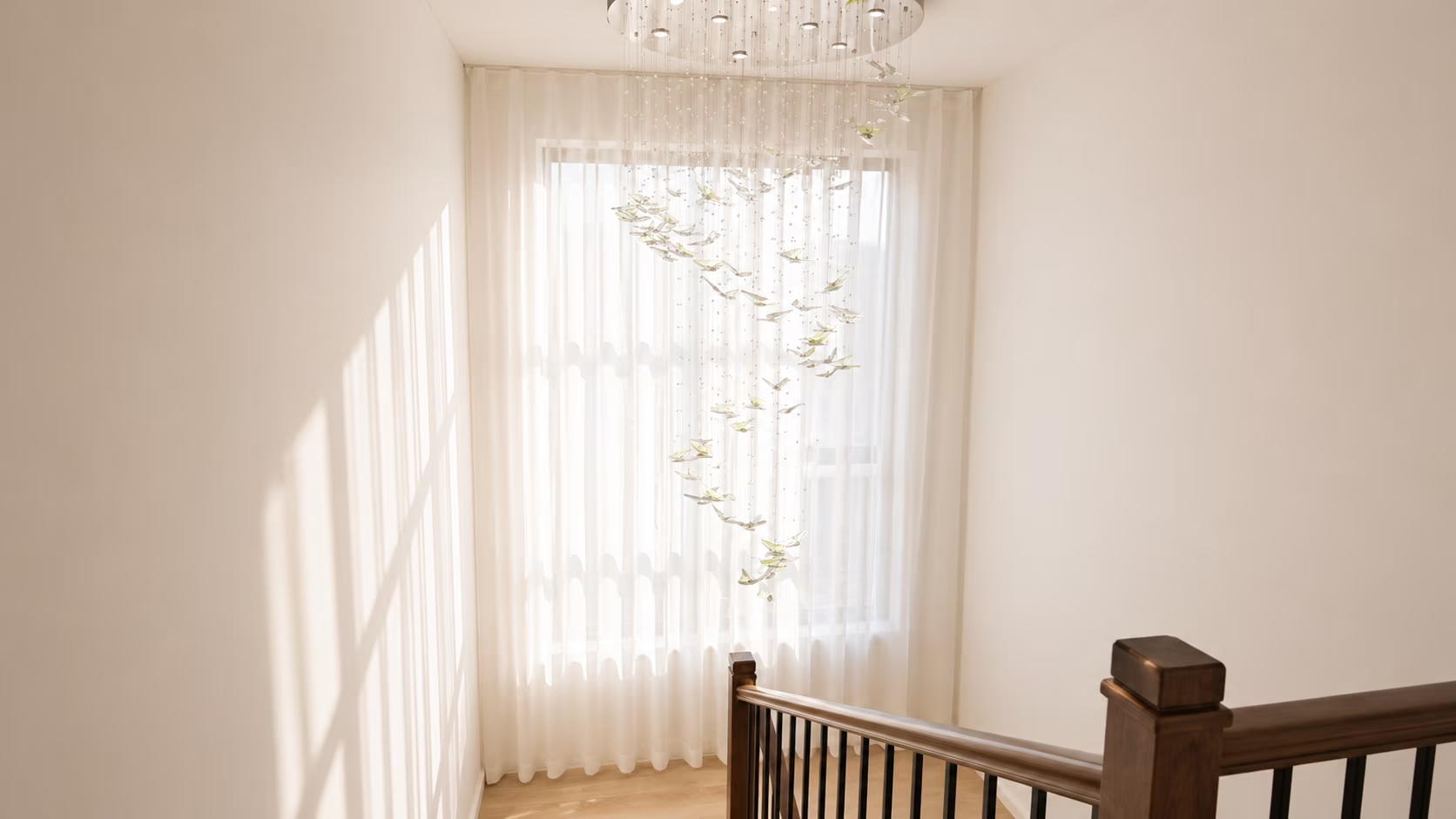
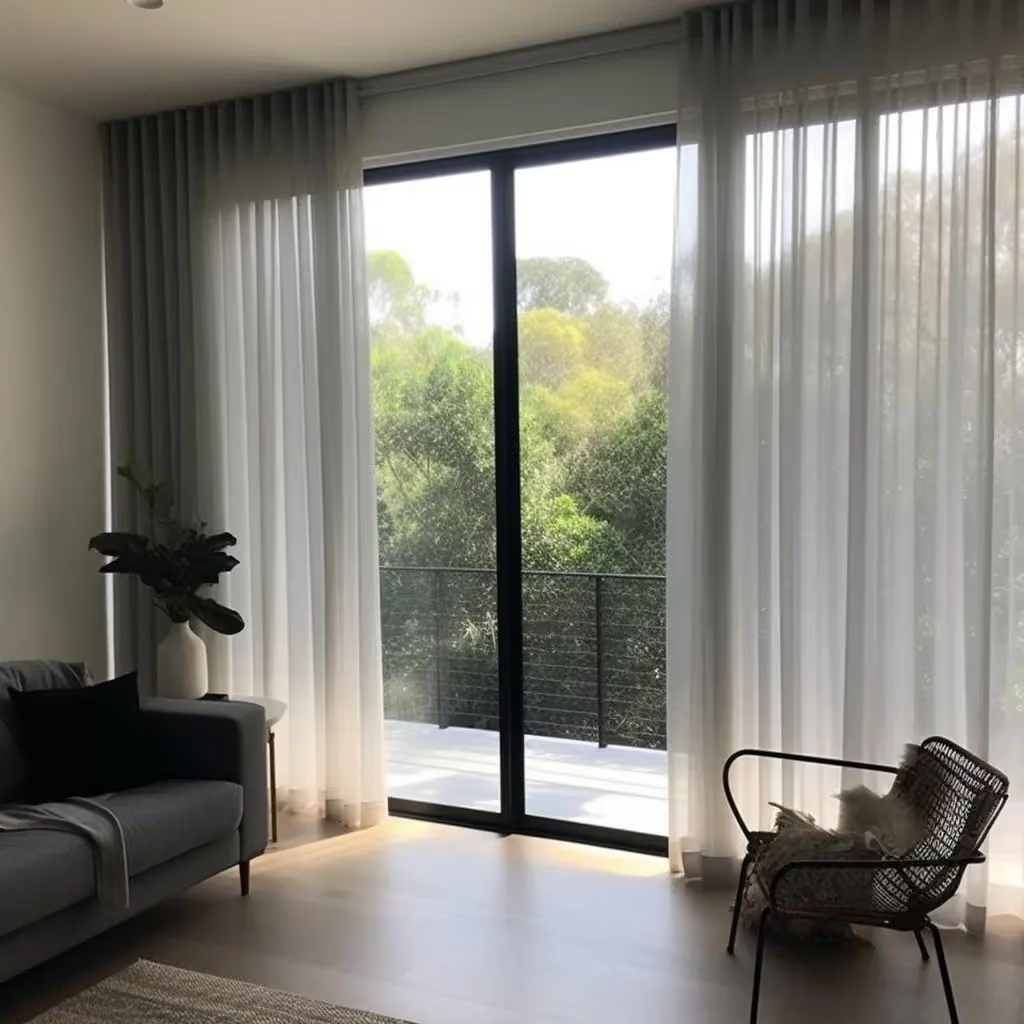
Full-height curtains can soften an apartment interior, improve privacy and make an ordinary window feel more generous. However, their appearance when closed is only one part of the design. Homeowners also need to consider where the fabric will sit when the curtains are open.
This gathered fabric is known as the curtain stack. If there is insufficient room beside the window, the open curtains may continue covering part of the glass, reducing daylight and narrowing the view. The fabric may also interfere with a sliding door, air-conditioning outlet, television unit or nearby furniture.
There is no single stack-space measurement that works for every apartment. The required width depends on the curtain fabric, heading, fullness, number of layers, track arrangement and total width of the opening. A light sheer curtain will usually form a different stack from a lined blockout curtain, even when both cover the same window.
This is why curtain stack space should be planned before the track is ordered. It should form part of the complete measurement process rather than being treated as a small installation detail.
Completed Canberra projects demonstrate how different curtain specifications create different practical requirements. The Griffith Apartment used all-linen sheer curtains to create softly filtered light. The QT Canberra Apartment used wool-finish lined curtains with a heavier, more substantial drape. At the Eastbourne Apartment, S-wave sheer and blockout curtains formed a dual-layer system that needed both layers to travel and stack comfortably.
These installations show why curtain stack space cannot be separated from fabric selection, track position and the way the apartment is used.
What Is Curtain Stack Space?
Curtain stack space is the horizontal area occupied by the gathered fabric when a curtain is fully open.
A pair of curtains normally creates one stack on each side of the window. A single-draw curtain places most or all of the fabric on one side. The stack may sit partly in front of the glass, completely beyond the window frame or in a combination of both positions.
The ideal arrangement depends on the room. If preserving the complete view is important, the track may need to extend beyond the window so most of the fabric can stack against the adjoining wall. If there is very little wall space available, some of the open curtain may need to remain in front of the glass.
This is particularly relevant in apartments because windows frequently sit close to corners, walls, bulkheads or balcony doors. A track cannot always extend equally in both directions.
The stack is also three-dimensional. Curtains do not only occupy width along the wall. Their folds project into the room. Double-layer systems require additional track separation so the front and rear curtains can move without pressing against one another.
A successful installation therefore considers stack width, fabric projection and track length together.
Why Does Curtain Stack Matter in an Apartment?
Large glazing is often one of an apartment’s most attractive features. It brings in daylight, frames the view and can make a compact living area feel more open. A curtain stack that unnecessarily covers the glass can reduce those benefits every day.
Research examining daylight at home and circadian health found that improved daytime light exposure in residential environments was associated with better circadian alignment, sleep and mental-health outcomes. Curtain planning is not a medical intervention, but the research reinforces the wider value of maintaining useful daylight when privacy and glare conditions allow it.
The Australian Government’s Your Home lighting guidance also explains that daylight can reduce dependence on artificial lighting. At the same time, uncontrolled sunlight can introduce glare and unwanted heat. Curtains therefore need to open sufficiently when daylight is useful and close properly when stronger control is required.
Stack space also affects access. A curtain beside a sliding balcony door should not collect across the part of the doorway used for entry and exit. Fabric that must be repeatedly pushed aside may become marked, creased or caught in the door.
In a smaller room, the stack can affect furniture placement. A sofa, bedside table or desk positioned too close to the track may prevent the curtain from hanging naturally. The fabric may bunch against the furniture or become difficult to open completely.
Planning the stack early allows the curtain and the room layout to support each other.
Is There a Standard Curtain Stack Calculation?
Curtain stack is sometimes described as a fixed percentage of the track or window width. That may provide a rough starting point, but it should not be treated as a manufacturing rule.
Two curtains covering the same opening can produce noticeably different stacks. A lightweight translucent fabric may compress into a relatively soft group of folds. A heavier lined curtain may require more space because its layers and construction create greater volume.
The heading also changes how the material gathers. S-wave curtains form regular folds that remain visible when the curtain is open. Other headings gather the material differently and may create a denser or less uniform stack.
Fullness affects the amount of material travelling along the track. Curtains generally contain more fabric than the flat width of the opening because the additional material creates folds. Increasing fullness can improve the appearance of the curtain, but it can also increase the amount of fabric that must gather at the side.
Track hardware, carriers, master carriers and overlap components may influence the final position as well. Motorised tracks can contain additional drive components, while curved tracks behave differently from straight tracks.
For these reasons, the final allowance should be determined from the selected fabric and track system during professional measurement. A generic online calculator cannot account reliably for every material, heading and installation condition.
How Fabric Weight Changes the Stack
Fabric is one of the most important influences on curtain stack space.
A lightweight sheer is designed to transmit and diffuse daylight. Its open construction and softer body may allow the folds to gather more gently. This can make sheers practical for wide apartment windows where the homeowner wants a continuous fabric finish without making the open curtain feel excessively heavy.
The Griffith Apartment demonstrates this approach. All-linen sheer curtains were selected to filter natural light throughout the apartment and create a soft, elegant atmosphere. Although the project confirms the product rather than publishing exact measurements, it illustrates the visual character homeowners may want to preserve: gentle fabric folds that soften the glazing without overwhelming the room.
A lined curtain has additional material and usually forms a more substantial stack. The face fabric, lining, seams and heading all contribute to its volume.
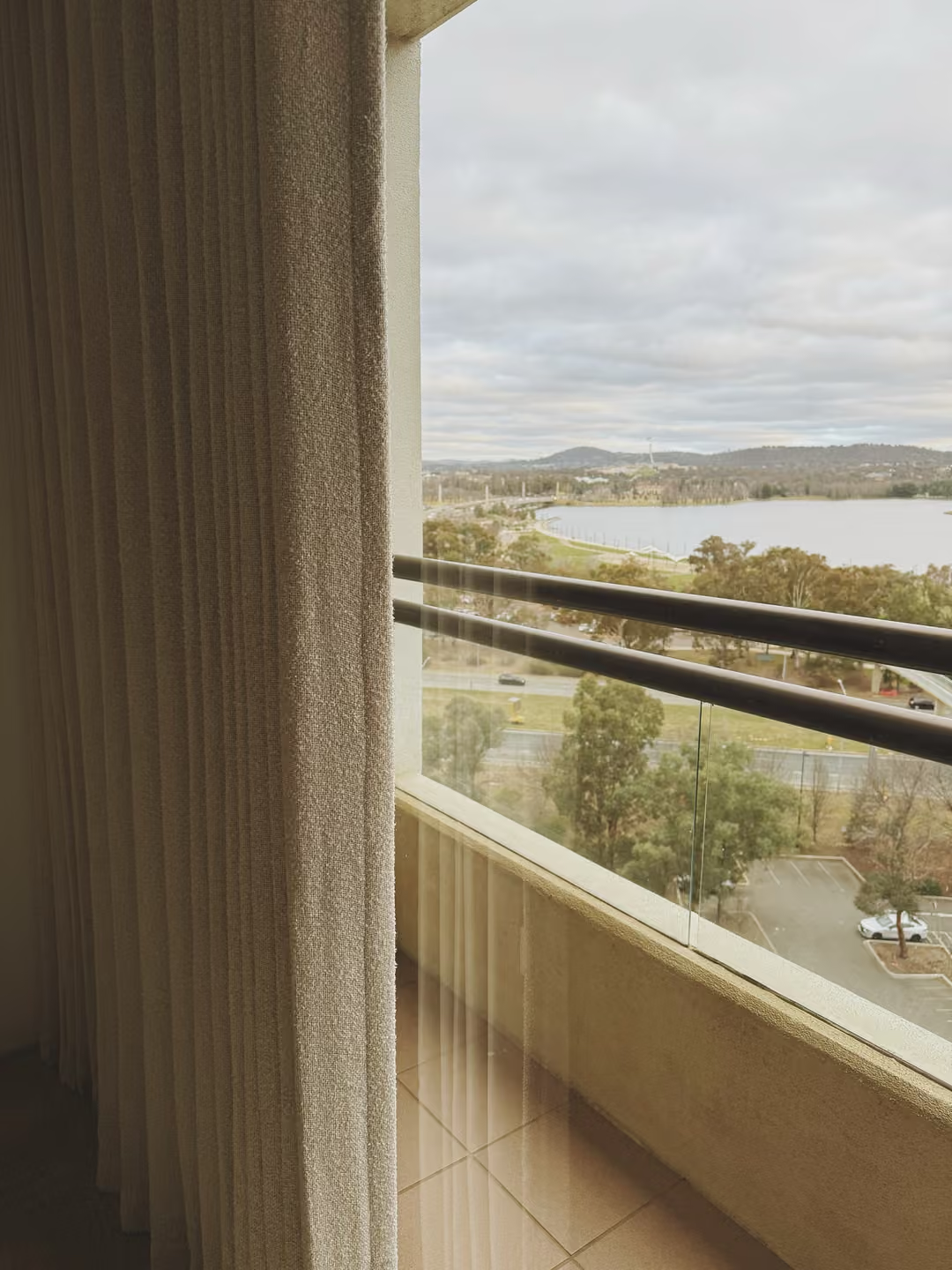
At the QT Canberra Apartment, wool-finish lined curtains were tailored to complement the building’s distinctive interior design. The lined construction created refined drape and texture, but this type of curtain needs to be planned differently from a single lightweight sheer.
Heavier does not automatically mean unsuitable for an apartment. It means the track length, wall space and stacking direction need to be considered alongside the fabric selection.
How S-Wave Curtains Affect Stack Space
S-wave curtains are popular in contemporary apartments because their repeated folds create a clean, consistent appearance from ceiling to floor.
The heading uses specialised carriers and spacing to maintain the wave pattern across the track. When the curtains are opened, these folds gather together rather than becoming completely flat. This gives S-wave curtains their structured appearance, but it also means the stack needs enough room to hold the repeated curves.
Track depth must be considered as well. The folds extend in front of and behind the track centre line. Nearby handles, roller blinds, walls and other curtain layers must remain clear of this movement.
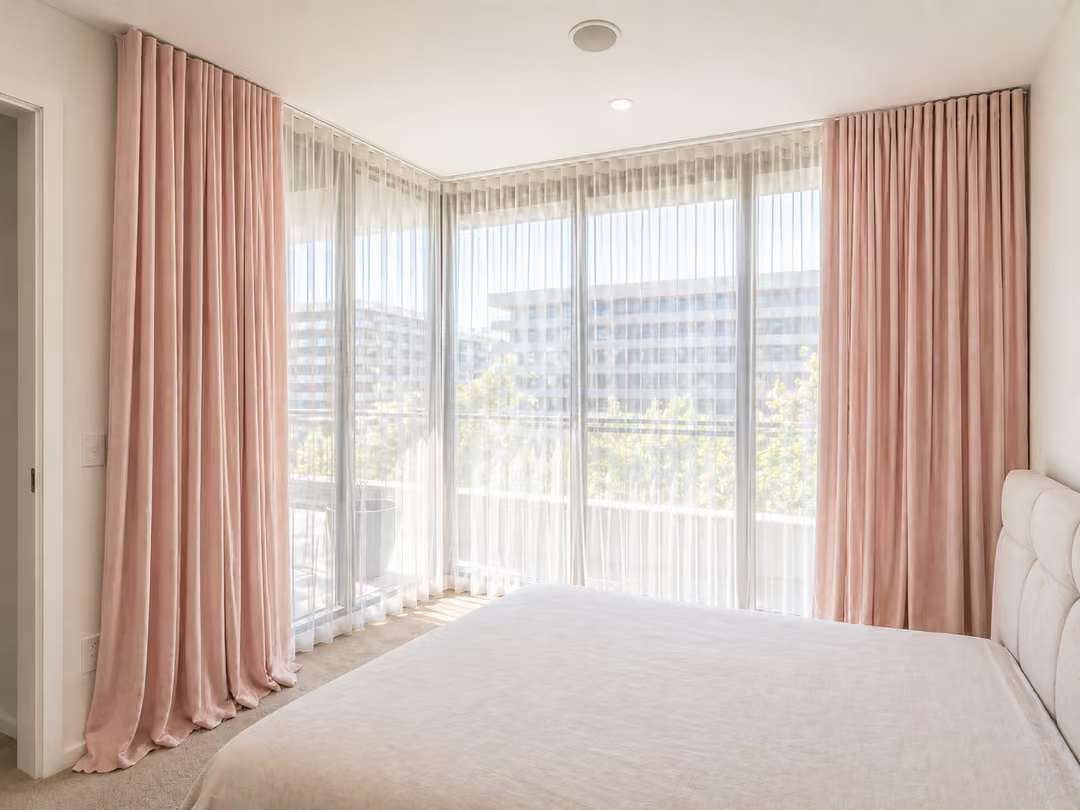
The Eastbourne Apartment used S-wave sheer and blockout curtains as a dual-layer installation. The sheers managed morning light and daytime softness, while the blockout curtains provided stronger privacy and coverage.
This project is useful because it demonstrates that two layers do not form one shared stack. Each curtain travels on its own track and requires room to gather. The track separation also needs to prevent the blockout fabric from pressing into the sheers during operation.
Sweet Home Blinds’ guide to why blockout curtains and sheer curtains work well in Canberra apartments explains the different daytime and night-time roles of the two layers. Stack planning is what allows both layers to perform those roles without making the window difficult to use.
Single-Draw or Centre-Opening Curtains?
The curtain opening direction determines where the fabric will gather.
Centre-opening curtains divide the fabric into two panels. One panel stacks on the left and the other stacks on the right. This creates a balanced appearance and can reduce the amount of material collected in one location.
However, equal stacks are only practical when enough space exists on both sides of the window. An apartment window placed close to a corner may have a generous wall area on one side and almost no available space on the other.
A single-draw curtain sends the fabric towards one selected side. This may be useful when the opposite side contains a sliding-door opening, a narrow return wall or a prominent view that should remain clear.
The decision should respond to the operation of the window or door. If a sliding door opens from the right, stacking the curtain on the left may provide clearer everyday access. The opposite arrangement may be better when the handle and active door panel are located on the other side.
External appearance is another consideration. Centre-opening curtains can create visual symmetry, but functional access is usually more important than making both stacks identical.
The correct direction should be established during measurement, after confirming the active door panel, furniture layout and available wall space.
Should the Track Extend Beyond the Window?
Extending the curtain track beyond the window frame can give the open fabric more space to sit away from the glass. This may preserve more daylight and reveal a wider view.
Track extension can also improve coverage when the curtain is closed. Additional width allows the fabric to return beyond the edges of the opening rather than finishing directly over the glass line. Sweet Home Blinds’ article about managing early sunlight with blockout curtains explains why track placement and coverage influence the amount of light entering around a curtain.
However, extending a track is not always possible. An adjoining wall, cupboard, bulkhead, sprinkler, air-conditioning grille or door may limit its length. Apartment owners may also need to consider ceiling construction and any building requirements affecting attachment to shared structural elements.
A long track does not automatically guarantee that the glass will be completely clear. The stack size still depends on the curtain construction. The extension must be large enough for the selected fabric and heading rather than chosen only for visual balance.
Where wall space is limited, a smaller amount of overlap across the glass may be an acceptable compromise. The important point is that the expected result should be discussed before manufacturing.
Planning Stack Space Around Sliding Doors
Sliding doors require more than visual coverage. They are active openings used for circulation, ventilation and balcony access.
A curtain stack positioned across the active door panel can become frustrating. Residents may need to move the fabric every time they enter the balcony, even when the curtains are otherwise open. Frequent handling can also transfer dirt and oils onto the fabric.
Where possible, the curtain should stack towards the fixed glazing or the wall beside the inactive section of the door. This keeps the main access route clearer.
The track should also allow the fabric to travel without catching on the door handle. The curtain projection and track position need to account for how far the handle extends into the room.
Natural ventilation may be another consideration. The Australian Government’s guide to choosing and upgrading an apartment recommends access to natural daylight and fresh air where possible. A curtain does not create ventilation, but its position should not make an operable door or window unnecessarily difficult to use.
When both sheers and blockout curtains cover a balcony door, the two stacks can become substantial. Their positions should be planned as part of the complete doorway rather than treated as decorative fabric added after the furniture is arranged.
Corners, Bulkheads and Unequal Wall Space
Apartment windows are not always centred on a clear wall. They may finish close to a corner, return into another glazed section or sit beneath a bulkhead containing building services.
A curtain approaching an internal corner needs sufficient room for its folds. If the track extends too close to the adjoining wall, the final folds may become compressed or rub against the surface.
Bulkheads can limit track placement and affect the apparent height of the curtain. A ceiling-mounted track may suit one section of the room but conflict with a lower ceiling detail beside the window.
Air-conditioning outlets and return-air grilles must remain clear. A curtain stack should not cover an outlet, restrict airflow or prevent a service panel from opening.
The same applies to smoke detectors, sprinklers, lighting and access panels. These elements should be reviewed before deciding how far the track can extend.
In some apartments, an asymmetrical solution will be more practical than forcing the curtain into a perfectly balanced layout. A larger stack on one side may preserve access and avoid building services while still creating a considered finish.
Coordinating Curtains With Roller Blinds
Curtains are frequently combined with roller blinds in apartment living areas and bedrooms. The blind provides compact privacy or blockout control, while the curtain adds softness and texture.
This arrangement can reduce the need for two full curtain layers, but the products still require appropriate clearance. The curtain folds must not catch on the roller, brackets, chain control or cassette.
The NUE Gungahlin development used roller blinds with linen sheers to balance glare and privacy with a lighter interior appearance. A similar combination can be useful where homeowners want the visual softness of a curtain but prefer a compact blind for stronger coverage.
Sweet Home Blinds’ broader guide to layering sheer curtains, blockout curtains and other window furnishings explains how individual products can perform separate roles. When a sheer is paired with a roller blind, stack planning remains important because the open curtain should still preserve useful glass area and avoid interfering with the blind controls.
The installation should be measured as one window system. Ordering the blind first and adding curtains later can work, but the existing brackets, control side and projection need to be checked.
Furniture and Joinery Can Reduce the Available Space
Curtain planning should include the furniture layout, particularly in compact apartments where walls perform several functions.
A television unit may occupy the wall beside a living-room window. A sofa may sit close to the curtain line. In a bedroom, a bedhead, bedside table or wardrobe may reduce the space available for the stack.
Built-in joinery creates a more permanent constraint. If a cabinet finishes against the window, the curtain may have nowhere to gather without covering part of the glass or overlapping the joinery.
Furniture can also interfere with the fabric projection. Even when the track has enough horizontal length, the folds need clear space to hang towards the floor.
The curtain should not be forced behind a sofa or pressed against shelving. This can distort the folds and make operation more difficult.
Where furniture cannot be moved, the installer may consider a different stacking direction, adjusted track position or an alternative window furnishing. A roller blind, honeycomb blind or Veri Shade may suit an opening where full curtains cannot operate comfortably.
The decision should be based on the complete room rather than the window in isolation.
Motorised Tracks and Curtain Stack
Motorisation can make wide or frequently used curtains easier to operate. It may also suit apartments where the track is high or the fabric is heavy.
The curtain stack itself does not disappear when the track is motorised. The same fabric still needs to gather at one or both ends. Motor components, drive units and master carriers may also affect the usable track length and final resting position.
Power and control planning must be completed before installation. A nearby outlet is not necessarily equivalent to a properly located supply for a concealed motorised system.
Motorised curtains should also have a clear travel path. Furniture, plants and decorative objects should not obstruct the fabric. Repeated contact with an obstacle can affect operation and damage the curtain.
Sweet Home Blinds’ guide to motorised curtains in Canberra provides more detail about track systems, power, controls and suitable applications.
Motorisation improves convenience, but it does not compensate for inadequate stack space. Measurement and fabric planning remain essential.
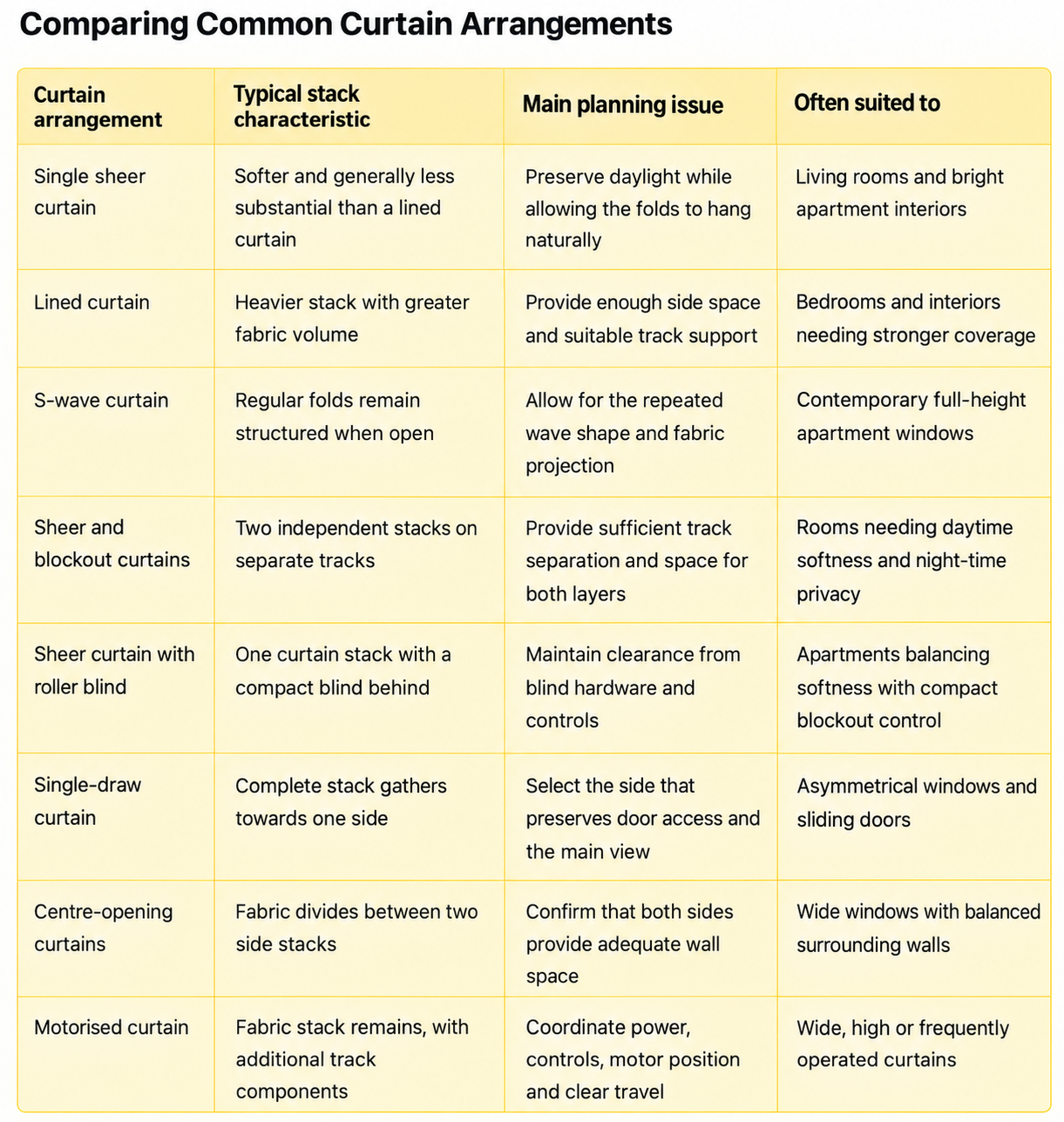
Real Canberra Examples
The Griffith Apartment demonstrates the light and flowing appearance of all-linen sheers. This type of installation suits homeowners who want to soften large areas of glass while preserving a bright atmosphere. The curtain stack still needs to be measured, but the visual result differs from a heavy lined treatment.
The QT Canberra Apartment provides the contrasting example. Wool-finish lined curtains were selected for their texture and refined drape. Their more substantial construction means fabric volume and track support are important parts of the plan.
Eastbourne Apartment shows what changes when two full curtain layers are installed. S-wave sheers and blockout curtains each require independent travel and stacking space. The completed system provides flexible light and privacy control because neither layer has been treated as an afterthought.
The Forrest House offers another useful design lesson. S-wave curtains were used to frame a tree view and complement the modern interior. Although it is a house rather than an apartment, the project demonstrates the importance of treating open curtains as a frame around the view. If too much fabric remained across the glass, that framing effect would be reduced.
These projects do not establish one universal stack allowance. They show why fabric, function and view need to be assessed together.
Why On-Site Measurement Matters
A floor plan can show the nominal width of a window, but it may not reveal every condition affecting the curtain.
Skirting boards, handles, power outlets, ceiling changes, uneven walls and installed joinery can alter the available space. Furniture may also have been selected after the architectural drawings were completed.
On-site measurement allows the track position to be checked against the finished room. The installer can identify where the curtain will start, where it will finish and how the fabric is expected to stack.
Fabric selection should ideally occur before the final track dimensions are confirmed. Measuring for a lightweight sheer and later changing to a lined curtain may change the required space and support.
The intended opening direction should also be recorded. It should not be left for the installer to guess on the day of fitting.
A professional measure does not mean every apartment can achieve a completely glass-clear stack. It means the available space, product requirements and likely compromises can be understood before the curtain is manufactured.
Frequently Asked Questions
How much wall space does a curtain stack need?
There is no universal measurement. The required space depends on the track width, fabric, lining, heading, fullness and whether the curtain opens from the centre or towards one side.
Can the curtain stack sit in front of the window?
Yes. This is common when there is limited wall space beside the glass. The trade-off is that the open curtain may reduce part of the view and daylight opening.
Do sheer curtains need less stack space than blockout curtains?
They often create a lighter and less substantial stack, but the result depends on the fabric, fullness and heading. The actual materials should be assessed before the track is ordered.
Do S-wave curtains take up more room?
S-wave curtains maintain regular folds when open, so they need enough room for those folds to gather and project from the track. Their exact stack depends on the complete specification.
Can curtains stack over a sliding door?
They can, but this may obstruct everyday access. Where possible, the stack should be directed away from the active door panel.
Do double curtains require twice as much stack space?
Not necessarily twice the horizontal width, but each layer creates its own stack and needs a separate track. The combined fabric volume and track projection require more planning than a single curtain.
Should curtains open from the centre or one side?
The best option depends on wall space, door direction, furniture and the main view. Centre opening creates two stacks, while a single-draw curtain concentrates the fabric on one side.
Can curtain tracks extend beyond the window?
Yes, when the wall, ceiling and nearby services allow it. Extending the track can help more of the open fabric sit away from the glass.
Does motorisation reduce curtain stack space?
No. Motorisation changes how the curtain is operated, but the fabric still needs somewhere to gather when open.
When should stack space be measured?
It should be considered during the initial site measure, after the fabric type, heading, layering arrangement and preferred opening direction have been discussed.
Planning Curtains That Work When Open and Closed
A well-designed curtain should perform in both positions. When closed, it should provide the intended light control, privacy and interior finish. When open, it should gather neatly without unnecessarily blocking the view, restricting a doorway or competing with furniture.
For Canberra apartments, this requires more than measuring the glass. The available wall area, ceiling structure, sliding-door operation, curtain heading, fabric weight and room layout all affect the final result.
A lightweight linen sheer at Griffith Apartment, a wool-finish lined curtain at QT Canberra Apartment and a double-layer S-wave system at Eastbourne Apartment cannot be planned using one generic stack allowance. Each installation responds to a different material and purpose.
Browse Sweet Home Blinds’ curtain collection, explore more completed Canberra projects, or read the company’s curtain and blind guides for more advice about fabrics, privacy and light control.
You can also visit the Sweet Home Blinds Fyshwick showroom by appointment to compare sheer, lined and blockout materials before making a final selection.
Planning full-height curtains for a Canberra apartment? Book a consultation with Sweet Home Blinds for professional measurement, fabric advice and installation planning that considers the track, stack, view and complete room layout.
Follow Sweet Home Blinds on Facebook and Instagram for completed apartment installations and Canberra window-furnishing inspiration.