
Window Furnishings for Canberra Townhouses: A Room-by-Room Guide
A townhouse rarely has one type of window repeated in every room. The ground floor may contain a wide sliding door, an open-plan living area and windows facing a shared path. Upstairs, bedrooms may require stronger privacy and room darkening. A stairwell can introduce a tall or difficult-to-reach window that needs a different approach again. For this reason, selecting one window furnishing for the entire home is not always the most practical solution. Roller blinds, honeycomb blinds, sheer...
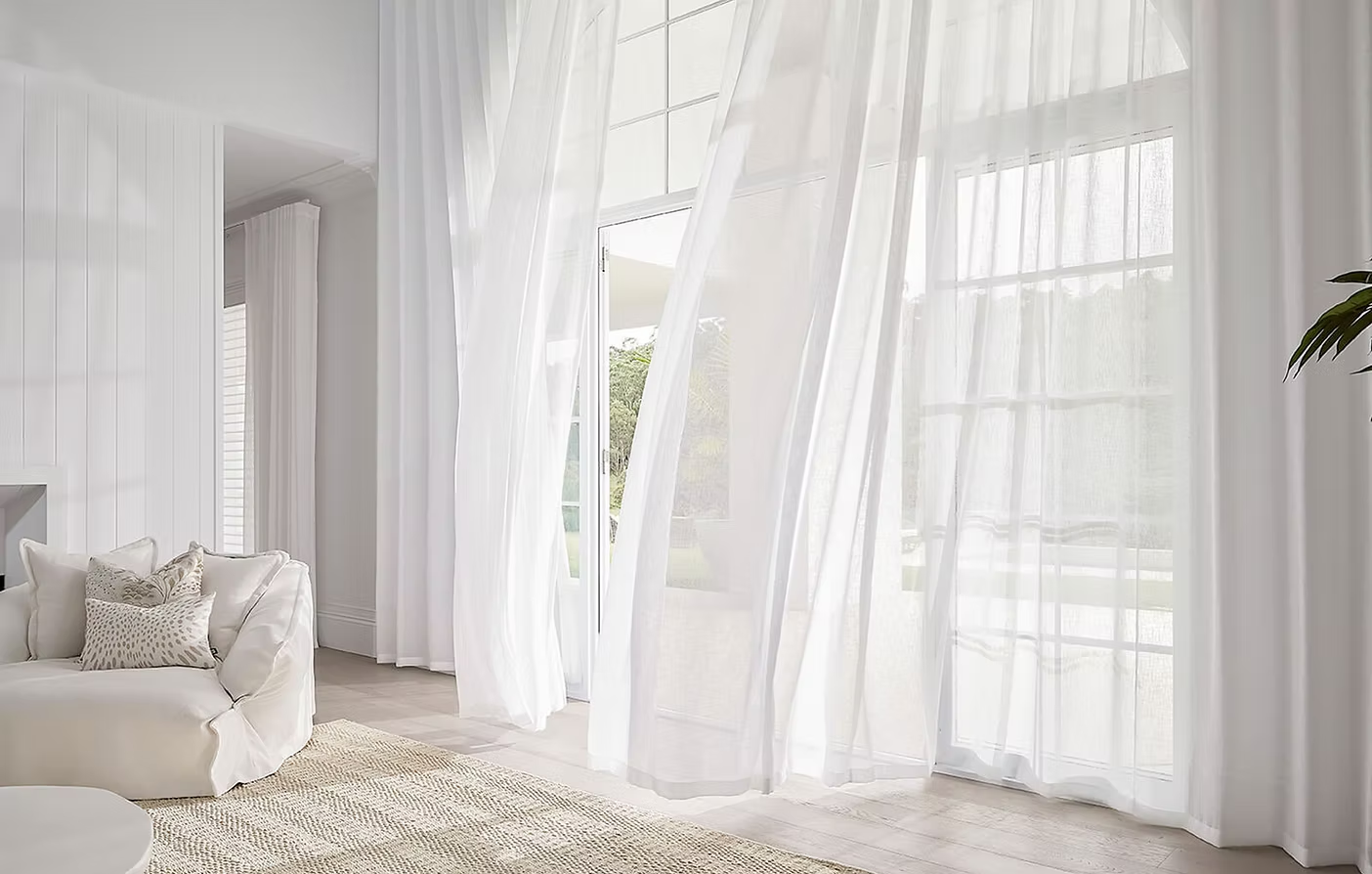
A townhouse rarely has one type of window repeated in every room. The ground floor may contain a wide sliding door, an open-plan living area and windows facing a shared path. Upstairs, bedrooms may require stronger privacy and room darkening. A stairwell can introduce a tall or difficult-to-reach window that needs a different approach again.
For this reason, selecting one window furnishing for the entire home is not always the most practical solution. Roller blinds, honeycomb blinds, sheer curtains and blockout curtains each solve different problems. The best result often comes from using a controlled combination rather than forcing one product into every room.
Three Canberra projects demonstrate these different approaches. Denman Terrace used honeycomb blinds with blockout and sheer curtains to create a layered whole-home solution. Turner Townhouse used roller blinds for clean lines, privacy and flexible everyday control. O’Connor Townhouse used sheer curtains to soften natural light and create a calm interior.
These projects do not suggest that every townhouse needs the same package. Instead, they show how the location, room function, window size and desired appearance can guide the product selection.
Why Are Townhouse Windows Different?
Townhouses combine features of detached houses and apartments. They usually extend across more than one level, but they may sit closer to neighbouring homes, shared driveways, footpaths or common areas.
This creates several window-furnishing challenges.
Ground-floor privacy can be important because people may pass close to the windows. Closing an opaque blind provides coverage, but it can also remove natural light and make a compact room feel more enclosed.
Upper-level rooms may receive more direct sunlight because nearby fences and landscaping provide less shade at that height. A bedroom facing east may become bright early in the morning, while a west-facing room may experience strong afternoon glare.
Townhouses also use space carefully. Furniture, television units, staircases, sliding doors and built-in joinery can reduce the wall area available for curtain stacking. A product must fit the window without making circulation or furniture placement more difficult.
Different façades can create different conditions within the same home. The front bedroom may need daytime privacy, while the rear living room needs glare control and convenient access to a terrace.
A useful townhouse plan therefore begins with the function of each room rather than the assumption that every window should look identical.
Starting With a Whole-Home Window Plan
A room-by-room plan does not mean that the finished home should look inconsistent. Products can perform different functions while sharing colours, hardware finishes and visual details.
For example, a townhouse may use blockout honeycomb blinds in bedrooms and light-filtering honeycomb blinds in a stairwell. The fabric performance changes, but the overall construction and colour remain consistent.
Another home may use roller blinds throughout private rooms and add sheer curtains to the living area. The blinds create a simple functional base, while the sheers introduce softness where it has the greatest visual impact.
Planning the complete home together also helps prevent installation conflicts. If curtains and blinds will be layered, the brackets, tracks and projection need to be measured as one system. Adding curtains after blinds have been installed may still be possible, but the available clearance can limit the result.
Colour selection becomes easier when it is considered across several rooms. A neutral palette can connect different products without requiring every fabric to be identical.
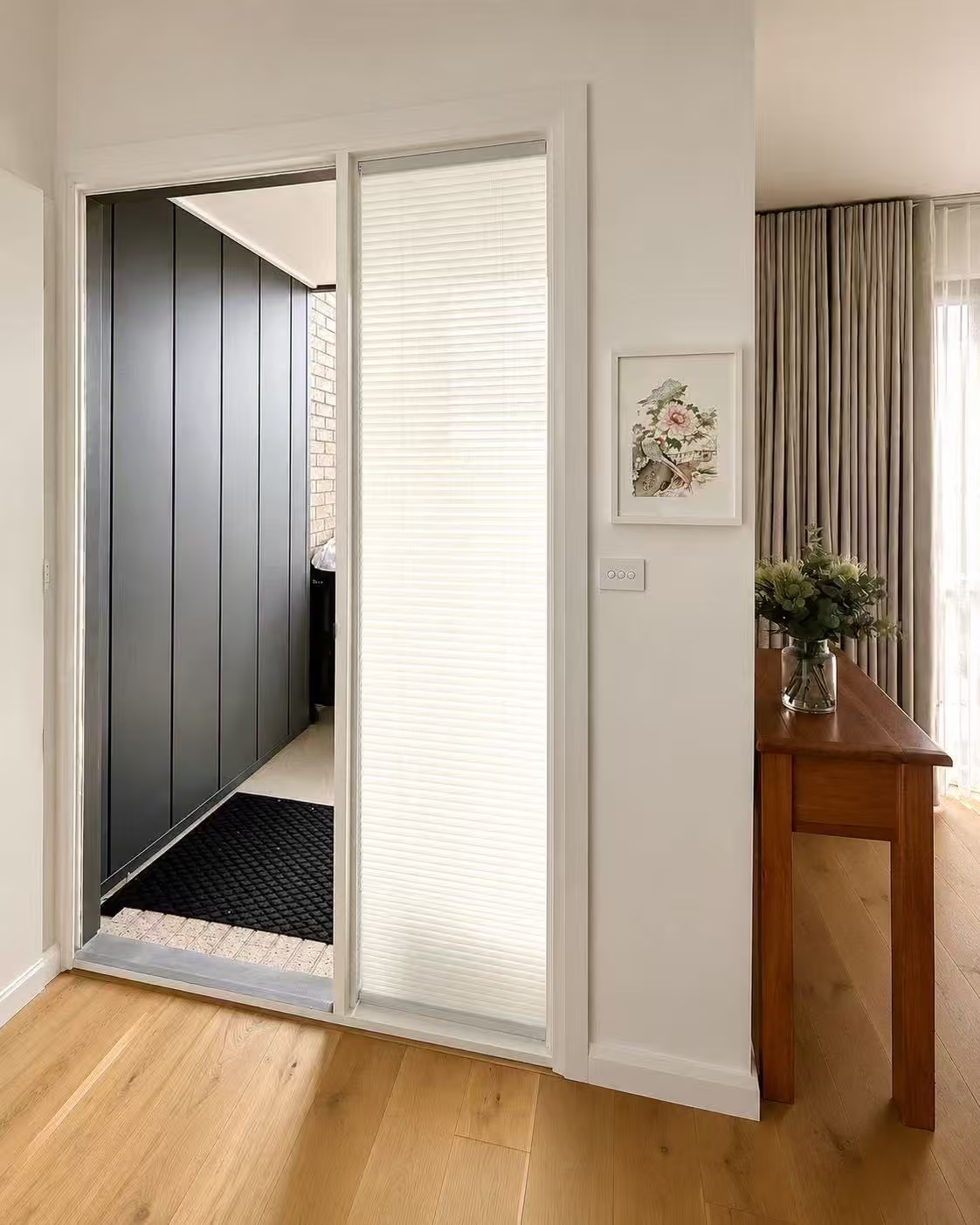
The Denman Terrace townhouse provides a useful example. Honeycomb blinds, blockout curtains and sheer curtains were combined to deliver privacy, light control, softness and everyday comfort. The project shows that a coordinated home can include several product types when each one has a clear role.
Ground-Floor Living Areas: Balancing Light and Privacy
A ground-floor living room often needs privacy without feeling permanently closed. This is especially relevant when the window faces a street, shared driveway, neighbouring residence or pedestrian area.
Sheer curtains can soften direct views during the day while allowing natural light to remain present. Their continuous fabric also reduces the hard appearance of large areas of glass.
Daytime privacy depends on the lighting conditions. When the exterior is brighter than the room, a sheer fabric can reduce direct visibility. The result changes at night when interior lights are on. Sheers should not be treated as dependable night-time privacy.
A separate blockout blind or curtain may therefore be required. The sheer layer can remain closed during the day, while the opaque layer provides stronger coverage after dark.
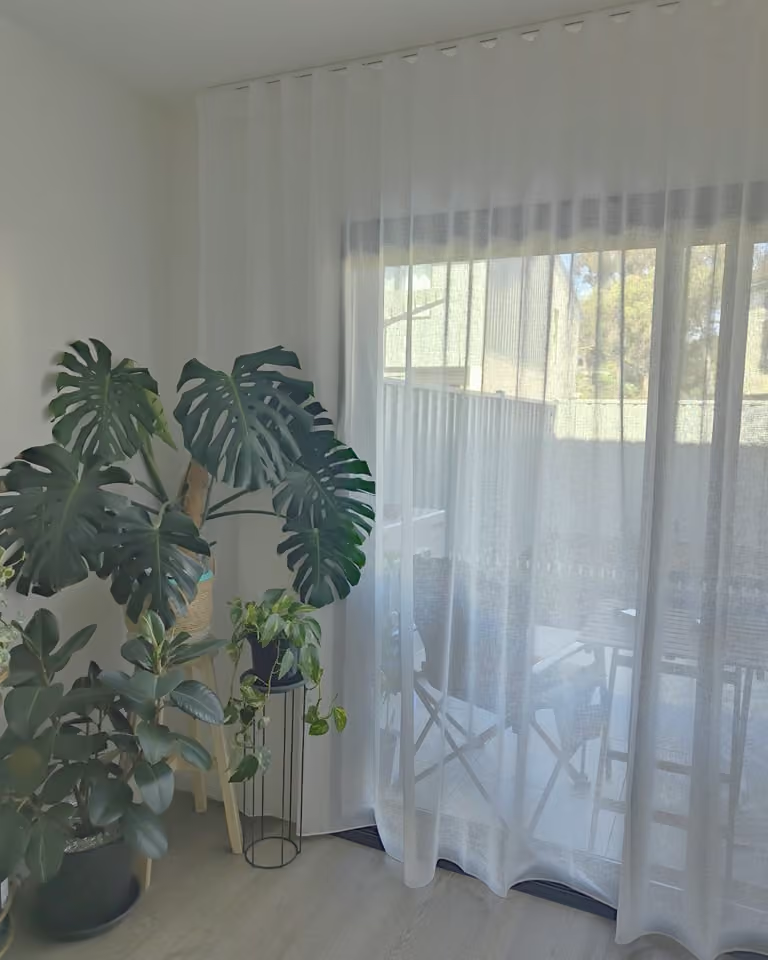
The O’Connor project demonstrates the softer part of this approach. At O’Connor Townhouse, sheer curtains were selected to filter natural light, add privacy and create a calm, elegant atmosphere.
This result may suit a living area where natural brightness is important and the homeowner does not want the window to feel visually heavy. Where night-time privacy is also required, the sheer curtain can be planned with a suitable blockout product.
Roller blinds offer a more compact alternative. They remain close to the glass and can be lowered when privacy is required. Light-filtering, sunscreen and blockout fabrics provide different levels of coverage.
The choice depends on whether softness or minimal projection is the greater priority.
Open-Plan Living and Dining Rooms
Open-plan rooms place greater visual emphasis on the windows because the living, dining and kitchen areas can all share the same view.
Full-height curtains can help connect several openings into one continuous architectural feature. Mounting the track close to the ceiling can also emphasise room height and reduce visual breaks across the wall.
However, a curtain needs sufficient stacking space. When opened, the fabric should not cover the main view, obstruct a doorway or collect behind a dining table.
In a smaller townhouse, a roller or honeycomb blind may preserve more usable wall and floor space. These products travel vertically and remain close to the window.
A layered solution can combine both benefits. A fitted blind manages glare and privacy, while the curtain provides softness and a more complete interior finish.
The layers need enough separation to move freely. A curtain that presses against a blind can affect its folds and operation. Door handles, window winders and projecting frames also need to be measured.
The decision should take account of furniture that may not yet be in the room. A curtain track can operate correctly during installation but become difficult to use after a television cabinet, sofa or dining setting is placed beside it.
Sliding Doors and Access to Outdoor Areas
Townhouse living areas frequently connect to a courtyard, balcony or terrace through a sliding glass door. The selected furnishing must provide coverage without making everyday access inconvenient.
Curtains can cover a wide door and adjacent glazing as one continuous treatment. They can be drawn away from the active door panel when access is required.
The stacking direction is important. If the curtain gathers on the same side as the door opening, residents may need to move a large amount of fabric whenever they go outside. Planning the stack around the active panel can make the system more comfortable to use.
Roller blinds can work across individual sections of fixed glass, but the blind position must not interfere with the door handle or opening path. A very wide blind may also become heavy, so several blinds may be required.
Separate blinds can create small light gaps between the fabrics. This may be acceptable in a living area but less suitable where strong room darkening is required.
Curtain length also needs attention near a busy doorway. Fabric that pools heavily on the floor may collect dirt or become caught under furniture. A carefully measured clearance usually provides a cleaner and more practical result.
Where fresh air and insect control are important, a retractable flyscreen may also need to share the opening. The curtain, screen and door should be measured as one arrangement so that their tracks and operating paths do not conflict.
Bedrooms: Darkness and Night-Time Privacy
Bedrooms normally require stronger coverage than living rooms. Privacy after dark, early morning sunlight and sleep comfort become more important.
Blockout roller blinds are a compact option. The fabric covers the main window area and rolls away neatly when opened. Small amounts of light can still enter around the sides, top or bottom, depending on the mounting position.
Blockout curtains can provide wider coverage because the fabric may extend beyond the window frame. A ceiling-mounted track and generous side coverage can reduce some of the light entering around the opening.
No product should automatically be described as creating total darkness. Functional gaps, doors and adjoining spaces can still introduce light.
Honeycomb blinds are another townhouse option. Their pleated cells form a fitted layer at the window, and different fabrics can provide light filtering or stronger blockout coverage. Their compact stack can suit bedrooms where curtain fabric would compete with a bed, desk or wardrobe.
The correct choice depends on the required darkness and the available space. A bedroom with limited wall area may suit a blind, while a larger primary bedroom may accommodate curtains or a layered arrangement.
Street-facing bedrooms also need daytime privacy. A sheer curtain, light-filtering blind or suitable adjustable system can reduce direct visibility without requiring the room to remain dark throughout the day.
Honeycomb Blinds for Compact Rooms
Honeycomb blinds use pleated fabric arranged into cellular sections. When opened, the fabric gathers into a compact stack. When closed, the cells create another layer between the room and the glass.
This construction can suit townhouse windows where the homeowner wants a softer appearance than a flat roller blind without using full-length curtains.
Honeycomb blinds are available in different fabrics and configurations. A light-filtering option can diffuse daylight, while a blockout option provides stronger privacy and room darkening.
The Australian Government’s Your Home glazing guide identifies snugly fitted blinds and curtains as useful additions to a window system. It also notes that honeycomb blinds are a popular fitted window furnishing.
The final performance still depends on the complete installation. Honeycomb blinds cannot repair air leakage around the window frame or replace efficient glazing.
They also require fabric-specific care. The pleated structure should not be scrubbed, crushed or exposed to unsuitable cleaning products. Households should follow the care instructions supplied with the selected material.
At Denman Terrace, honeycomb blinds formed part of a broader layered specification rather than being treated as the only product suitable for every window. This is a useful approach for townhouses: use the compact fitted blind where it works best and introduce curtains where greater softness or coverage is needed.
Roller Blinds for Simple Everyday Control
Roller blinds are practical where clean lines, straightforward operation and minimal use of space are priorities.
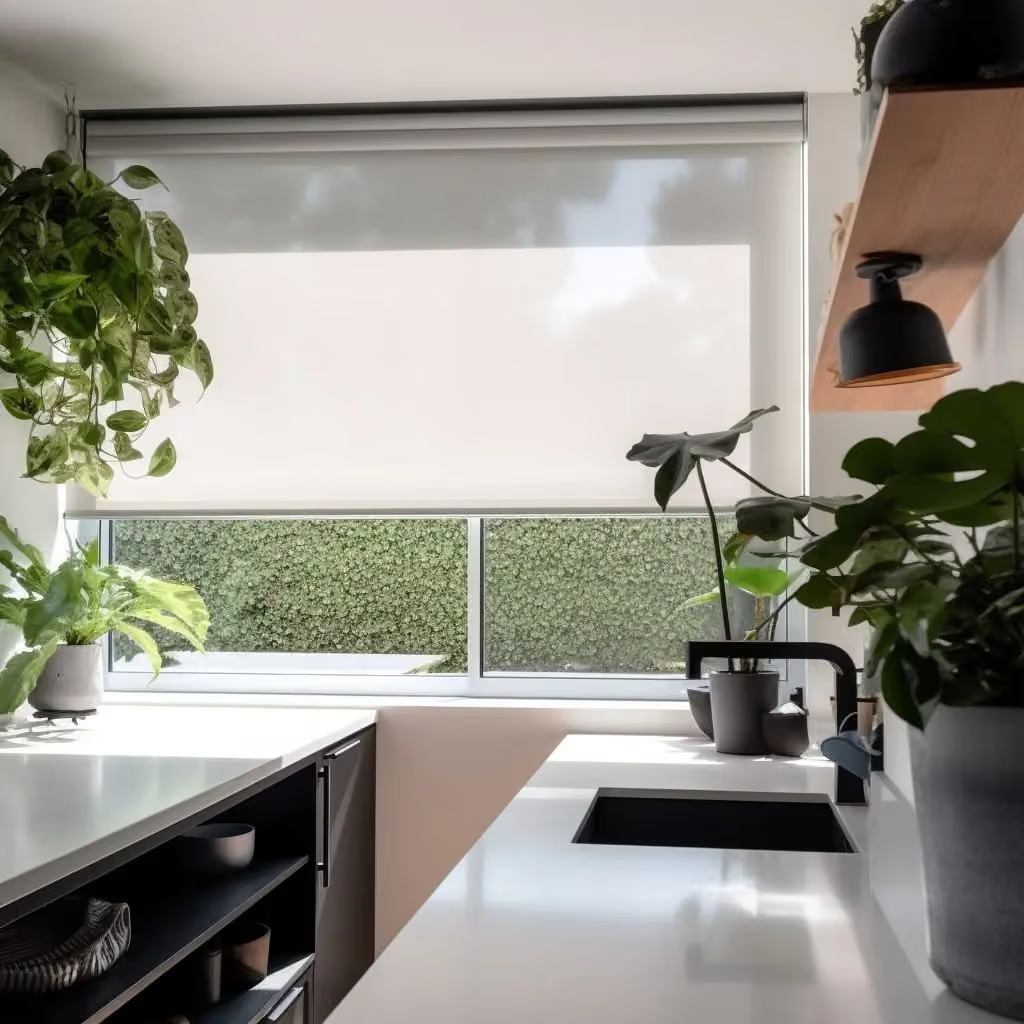
The Turner Townhouse project demonstrates this approach. Roller blinds were selected to provide privacy, flexible light control and a neat everyday finish.
A roller blind can be stopped at different heights, allowing part of the window to remain uncovered. However, because the fabric lowers from the top, covering a low privacy concern may also remove some daylight from the upper section.
The selected fabric has a major influence on performance. A sunscreen fabric can reduce glare and retain some daytime outward visibility. A light-filtering fabric diffuses light more broadly, while a blockout fabric provides opaque coverage.
Sunscreen fabric should not be relied upon for dependable night-time privacy. When the interior is illuminated and the exterior is dark, visibility can change.
Roller blinds are also relatively restrained visually. This may suit a townhouse with limited space or a minimalist interior. In a room that needs more softness, the blind can be paired with a sheer curtain.
Very wide windows require careful planning. One oversized blind may be unsuitable, while several blinds can create gaps. The window divisions, operating controls and furniture layout should be considered during measurement.
Stairwell and Landing Windows
Stairwell windows can be difficult because they are viewed from several levels and may be hard to reach.
A window positioned above a stair flight cannot always be operated safely using an ordinary chain or wand. The floor below may not provide stable access, and furniture cannot be placed conveniently beside the window.
A motorised blind may be worth considering where manual operation is impractical. Power, control location and future maintenance access need to be planned before installation.
A light-filtering honeycomb blind can also suit a stairwell that needs glare reduction without becoming dark. Its fitted appearance does not require floor space for curtains.
If curtains are used, their length and movement must not interfere with the handrail, landing or steps. The track requires a suitable fixing surface, and installation access needs to be assessed professionally.
The orientation of the stairwell matters. Strong sunlight can create sharp contrast between bright glass and darker steps. A light-filtering layer can make the transition feel more gradual while preserving useful daylight.
Privacy may be less important at the upper part of the window but more important at the lower level. A product that allows separate adjustment may be useful, depending on the available system and window dimensions.
Home Offices and Flexible Rooms
Many townhouses use a bedroom, landing or ground-floor room as a home office. Screen glare becomes a more important consideration in these spaces.
A roller blind provides simple vertical adjustment. It can cover the part of the window responsible for direct brightness, although lowering it may also remove some useful daylight.
A light-filtering honeycomb blind can diffuse the window more evenly. Some systems may offer alternative operating configurations, but availability depends on the product and window.
Sheer curtains soften the contrast between a bright window and the screen. They are useful when the goal is to maintain a bright atmosphere rather than darken the room.
The desk position should be considered with the window furnishing. A monitor placed directly in front of a bright window can create uncomfortable contrast, while a window reflected in the screen can make work more difficult.
The Australian Government’s lighting guidance explains that useful daylight can reduce reliance on artificial lighting, although poorly controlled light may introduce glare.
The best home-office solution manages direct brightness without making the room unnecessarily dark. If the space must also function as a guest bedroom, a separate blockout layer may be needed.
Bathrooms, Kitchens and Utility Areas
Bathrooms, kitchens and laundries expose window furnishings to different conditions from bedrooms and living rooms.
A full-length fabric curtain may be unsuitable beside a sink, bath, cooking surface or narrow circulation path. A compact blind can provide privacy while remaining clear of the floor and nearby work surfaces.
Material selection is important in rooms where moisture, splashes or cooking residue may occur. Not every blind fabric is designed for the same environment.
A bathroom window often needs privacy throughout the day without making the room feel dark. A suitable light-filtering or opaque blind can provide coverage, depending on the window position.
Ventilation should not be obstructed. The blind must allow access to handles, louvres or opening sections where these are used for airflow.
Cleaning instructions need to be checked before the product is ordered. A surface that can be gently maintained may be more practical than a fabric requiring specialist treatment in a frequently used utility space.
These smaller rooms should still relate visually to the rest of the townhouse. Hardware colour and general fabric tone can remain consistent even when the material changes for practical reasons.
Managing Canberra’s Winter and Summer Conditions
Townhouses can experience different temperatures across their levels. Upper rooms may become warmer during summer, while lower rooms and windows can feel colder during winter.
Window size, orientation, glazing, air leakage and external shading all influence indoor comfort. Window furnishings can add another layer, but they should not be presented as a replacement for the building envelope.
Blockout curtains can extend beyond the frame and cover some of the surrounding wall. Honeycomb and roller blinds remain closer to the glass and require an appropriate fit to perform effectively.
The Your Home glazing guide explains that window furnishings can improve the overall thermal performance of window systems. It also notes that reducing gaps around blinds and curtains can improve their performance.
During winter, residents can open appropriate window furnishings when useful sunlight reaches the room and close them before temperatures fall in the evening.
During summer, internal furnishings can reduce direct brightness and provide some coverage. However, they act after sunlight has passed through the glass. The Australian Government’s shading guidance explains that suitable external shading is generally more effective at limiting unwanted summer heat gain.
A west-facing upper bedroom may therefore require a different fabric or layer from a shaded ground-floor living room.
Curtains, Blinds or a Layered Combination?
There is no universal product that solves every townhouse window.
Curtains provide softness, texture and broad coverage. They can make a living area or primary bedroom feel more complete, but they require projection and stacking space.
Roller blinds provide compact and simple control. They work well in rooms where furniture sits close to the window, although side gaps and a more minimal appearance need to be considered.
Honeycomb blinds combine a fitted profile with a softer pleated structure. They can suit compact bedrooms, landings and windows where curtains would use too much space.
Layered systems combine different strengths. A blind can manage privacy and glare, while a sheer curtain introduces softness. A blockout curtain can add stronger night-time coverage over a fitted blind.
More layers also require more space and a larger budget. Brackets and tracks must be positioned so the products do not interfere with one another.
The Denman Terrace project demonstrates this balanced approach. Honeycomb blinds, blockout curtains and sheer curtains were used as parts of one coordinated townhouse solution rather than competing products.
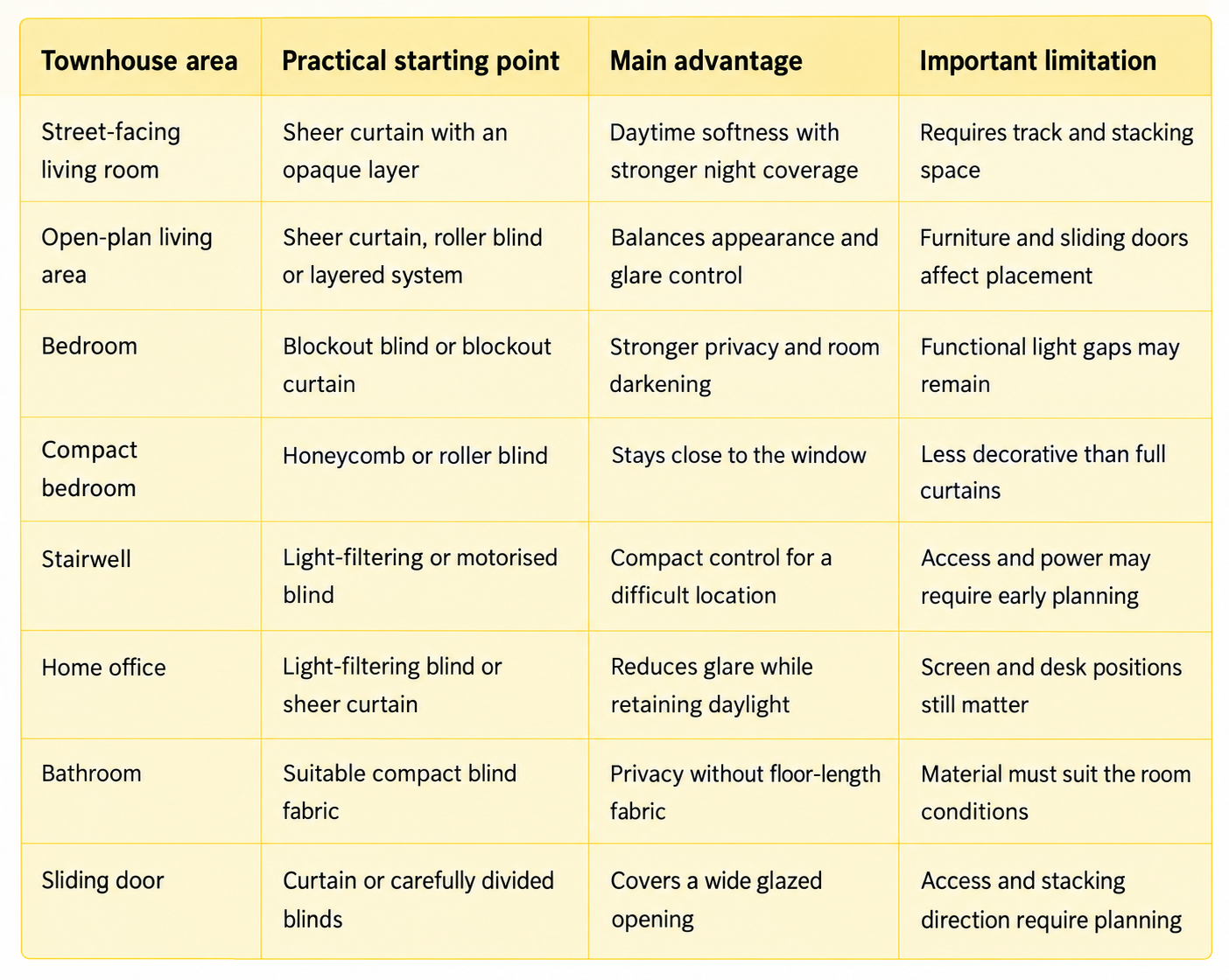
Appearance and Consistency Across Two Levels
A townhouse can feel disconnected if every room uses unrelated colours and hardware. Consistency should be created through a controlled palette rather than one identical product.
Warm white, soft grey or neutral fabric tones can connect blinds and curtains across different floors. Track and bracket finishes can also be coordinated with window frames, door hardware or other interior details.
Full-height curtains create strong vertical lines and can emphasise ceiling height. Roller blinds create a quieter, more architectural result. Honeycomb blinds add texture without introducing large volumes of fabric.
Rooms visible from one another deserve particular attention. If the living room, dining area and stairwell form one open space, their window furnishings should relate visually even when they perform different functions.
The exterior appearance may also matter. Different fabric colours or blind positions can be visible across the townhouse façade. This may be subject to development or strata requirements in some properties, so homeowners should check any applicable rules before changing externally visible window treatments.
The O’Connor, Turner and Denman Terrace projects represent three distinct design directions: soft sheers, compact roller blinds and a more complete layered system. Each can look coherent when the product choice responds to the architecture.
Cleaning and Long-Term Maintenance
Maintenance requirements should be considered before the products are selected, especially where windows are difficult to reach.
Roller blinds use a flat fabric panel, which can make routine dust removal relatively straightforward. The appropriate cleaning method still depends on the selected material.
Honeycomb blinds require careful handling so their pleats and cellular structure are not crushed or distorted. Dust may need to be removed gently according to the supplier’s instructions.
Curtains contain more fabric and may collect dust, pet hair and household odours. Routine care may include careful vacuuming with a soft brush attachment. Washing, steaming or professional cleaning requirements depend on the fabric, lining and construction.
Curtains and blinds should not be placed in a washing machine or treated with cleaning products unless the supplied instructions specifically permit it.
High windows may require professional access for cleaning or maintenance. This should be considered when selecting a manually operated or motorised system.
Homeowners can review Sweet Home Blinds’ general care and maintenance guidance, while continuing to follow the instructions supplied with the installed product.
Safety in Multi-Level Homes
Cords and chains require careful attention in homes with children. Beds, cots, chairs and other climbable furniture should not be positioned where children can reach window-covering controls.
Product Safety Australia’s mandatory standard for blinds, curtains and window fittings includes requirements relating to corded internal window coverings and their installation.
Safety devices, warning labels and suitable control positions form part of the complete installation. They should not be removed or treated as optional accessories.
Motorised or cordless options may be considered where accessible controls are a concern. The selected system still needs to suit the window, available power and intended operation.
Multi-level homes also introduce access risks. Residents should not stand on stair treads, furniture or unstable ladders to reach a high blind. Difficult windows should be planned with safe daily operation and future servicing in mind.
Safety is easiest to resolve during measurement, when the location of beds, desks, sofas and other furniture can be discussed.
Cost and Long-Term Value
Townhouse pricing depends on the number and size of windows, selected products, fabrics, tracks, controls and installation access.
Roller blinds are often a straightforward starting point, but a townhouse containing several wide windows may require multiple units. Double roller blinds, premium fabrics and motorisation will change the final cost.
Honeycomb-blind pricing depends on the fabric, cell construction, operating configuration and dimensions. The comparison should consider the desired result rather than only the initial price.
Curtain pricing is influenced by track length, ceiling height, fabric, lining and fullness. A wide sliding door may require much more fabric than its glass width suggests.
Layering increases cost because more than one product is being manufactured and installed. It can still offer good value where the layers perform separate functions that residents will use every day.
A room-by-room plan helps direct the budget. Homeowners may choose a simple blind in a bathroom or utility room while investing in full-height curtains for the main living area.
Professional measurement can also prevent costly mistakes involving handles, narrow recesses, uneven openings and insufficient stacking space.
Three Canberra Townhouse Approaches
The Denman Terrace project represents the most layered approach. Honeycomb blinds, blockout curtains and sheer curtains were combined to provide privacy, flexible light control, softness and everyday comfort across the townhouse.
The Turner Townhouse project demonstrates a simpler direction. Roller blinds provided clean lines, privacy and practical daily light control without requiring large fabric stacks beside the windows.
The O’Connor Townhouse project shows how sheer curtains can shape the atmosphere of a home. They softened natural light, added privacy and created a calm, elegant finish.
Together, the projects show three valid responses to townhouse living. Denman Terrace uses several products for a layered whole-home result. Turner prioritises compact practicality. O’Connor emphasises natural light and softness.
The correct approach depends on the architecture and household rather than a universal ranking of the products.
Frequently Asked Questions
Should every room in a townhouse use the same window furnishing?
No. Different rooms have different privacy, light-control and space requirements. Products can vary while sharing coordinated colours and hardware.
Are sheer curtains suitable for a street-facing living room?
They can reduce direct daytime visibility under suitable lighting conditions. A separate opaque blind or curtain may be required for dependable night-time privacy.
Which window furnishing is best for a townhouse bedroom?
Blockout roller blinds, honeycomb blinds and blockout curtains can all work. The best choice depends on the required darkness, available space and desired appearance.
Are honeycomb blinds suitable for small rooms?
Yes. Their fitted construction and compact stack can suit rooms where full-length curtains would use too much wall or floor space.
Can curtains be installed over blinds?
Often yes, provided there is enough clearance for both products to operate without interference. They should preferably be planned and measured together.
What is best for a townhouse sliding door?
Curtains can cover a wide opening continuously, while blinds may suit separate glazed sections. The active door panel, handles and stacking space must be considered.
Are motorised blinds useful in a townhouse?
They can be useful for stairwell windows, high glazing or openings positioned behind furniture. Power, controls and maintenance access need to be planned.
Do window furnishings improve winter comfort?
They add another layer at the window and may improve comfort when properly fitted. They cannot replace efficient glazing, insulation or draught sealing.
Which option is easiest to maintain?
Roller blinds are generally straightforward because they use a flat fabric panel. Actual cleaning requirements depend on the selected fabric and supplier instructions.
Planning Window Furnishings for the Complete Townhouse
A successful townhouse solution does not begin by selecting one product for every room. It begins by identifying what each window needs to do.
Ground-floor living rooms may need filtered daylight and privacy. Bedrooms require stronger night coverage. Sliding doors need convenient access. Stairwell windows must be safe to operate, while bathrooms need compact products suited to their conditions.
The product palette can then be kept controlled. Roller blinds provide simple everyday operation. Honeycomb blinds offer a compact pleated layer. Sheer curtains soften natural light, and blockout curtains provide broader opaque coverage.
Denman Terrace demonstrates how these products can be combined within one townhouse. Turner Townhouse shows the value of a clean roller-blind specification, while O’Connor Townhouse demonstrates the calm atmosphere created by sheers.
Browse more completed Canberra residential projects, explore the complete range of curtains, blinds, shutters and screens, or book a consultation to compare fabrics, operating systems and installation options.
Planning window furnishings for a Canberra townhouse? Contact Sweet Home Blinds for professional measurement, product advice and installation across Canberra and surrounding regions.
Follow Sweet Home Blinds on Facebook and Instagram for completed townhouse projects and Canberra window-furnishing inspiration.