
Why Canberra School Halls Need Motorised Blinds
Learn how motorised blinds can support light control, quiet operation, safety and everyday use in Canberra school halls, with Campbell High School as a completed project example.
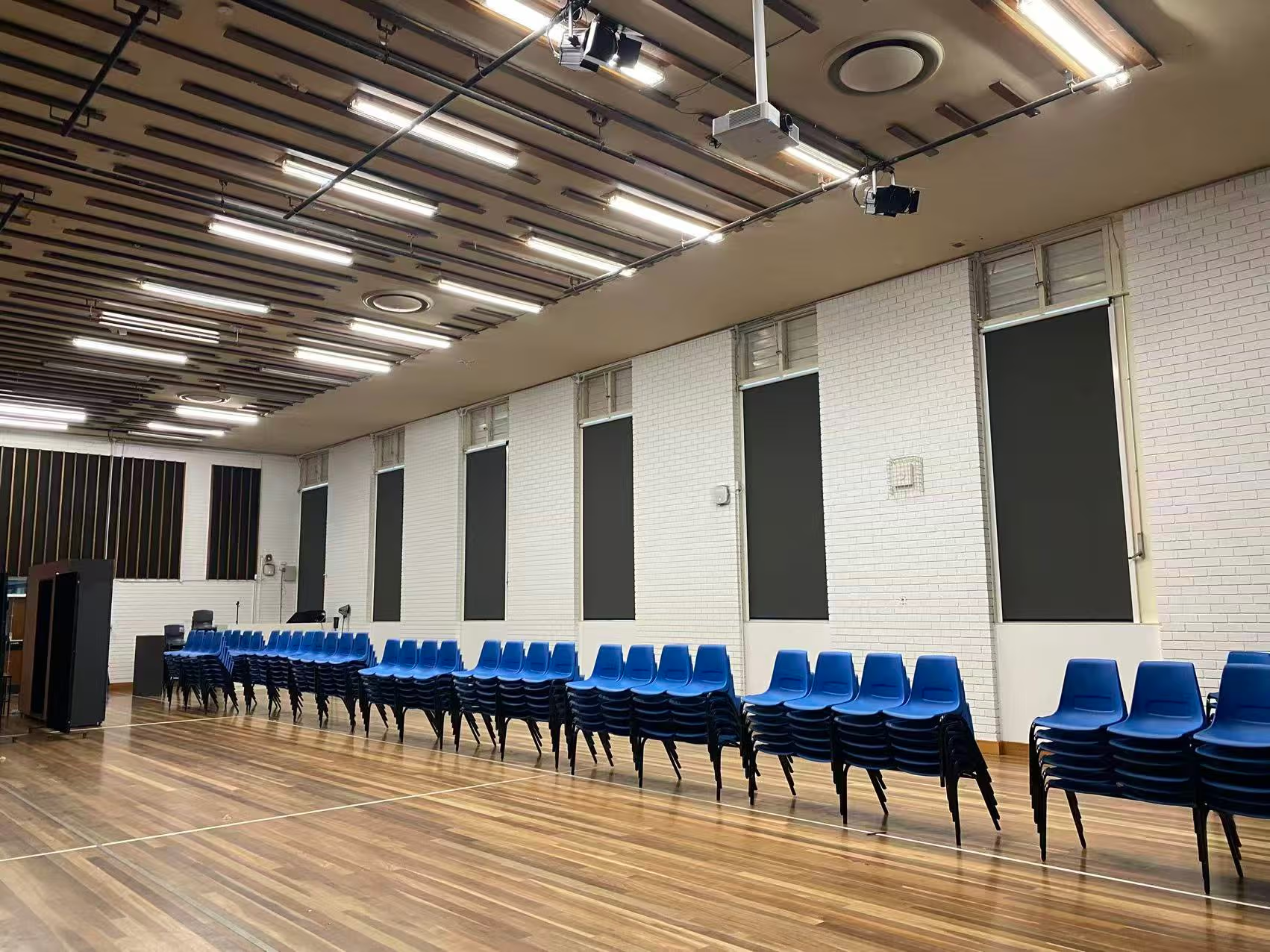
A school hall needs to support many different activities. The same space may be used for assemblies in the morning, presentations during the school day, performances in the evening and community events outside normal hours.
These activities do not always require the same lighting conditions. An assembly may benefit from natural daylight, while a projected presentation may require stronger glare control. A performance needs window furnishings that can operate without creating unnecessary noise or interrupting the event.
Large or high windows can make manual blinds difficult to manage across such a flexible space. Staff may need to operate several blinds separately, reach controls positioned beside furniture or access windows that were not designed for regular manual handling.
Motorisation can make the process more practical. Instead of visiting every window, an authorised user may be able to operate individual blinds or coordinated groups through a suitable control system. The exact operation depends on the selected motor, electrical arrangement and control configuration.
The completed Campbell High School project provides a local example. Sweet Home Blinds installed Somfy motorised blinds throughout the school hall, with quiet operation selected to suit performances, presentations and everyday use.
This project demonstrates why motorised blinds in an educational building should not be treated as a residential smart-home feature transferred into a larger room. Light control, operating noise, accessibility, electrical planning, product durability and long-term maintenance all need to be considered as part of the hall’s complete design.
Why School Halls Need Flexible Light Control
A school hall is usually more versatile than a standard classroom. Its lighting needs can change several times within one day.
Natural daylight may be desirable during assemblies, examinations, meetings or general school activities. It can make the hall feel more open and reduce dependence on artificial lighting when outdoor conditions are suitable.
However, direct sunlight can also create problems. Bright light may fall across a stage, wash out a projection screen or produce uncomfortable contrast between a window and the surrounding interior. Reflections can affect televisions, presentation displays, polished floors and other surfaces.
The Australian Government’s Your Home lighting guidance explains that daylight can reduce the need for artificial lighting, although poorly controlled direct sunlight may introduce glare and unwanted heat. Although the guide is written mainly for residential design, the underlying distinction remains useful in a school hall: daylight can be valuable without every window needing to remain fully uncovered.
The goal is therefore not to make the hall permanently dark. It is to give staff practical control over the amount of light entering the space.
Motorised blinds can support this flexibility because they can be adjusted as room use changes. Staff can open the blinds when daylight is helpful and lower them when glare interferes with a presentation or activity.
What Makes Motorisation Useful in a Large Hall?
Manual blinds can be practical in smaller rooms with a limited number of accessible windows. A school hall presents a different operating environment.
The windows may be high, wide or distributed along several walls. Operating each blind separately can take time, particularly when the room needs to change quickly between activities.
A motorised system can reduce this repeated physical handling. Depending on the final controls, multiple blinds may be operated together or divided into separate groups. This can help staff prepare the room without moving between every window.
Motorisation may also improve consistency. When several manual blinds are adjusted by different people, their positions may vary. A coordinated system can make it easier to align a group of blinds at a suitable height.
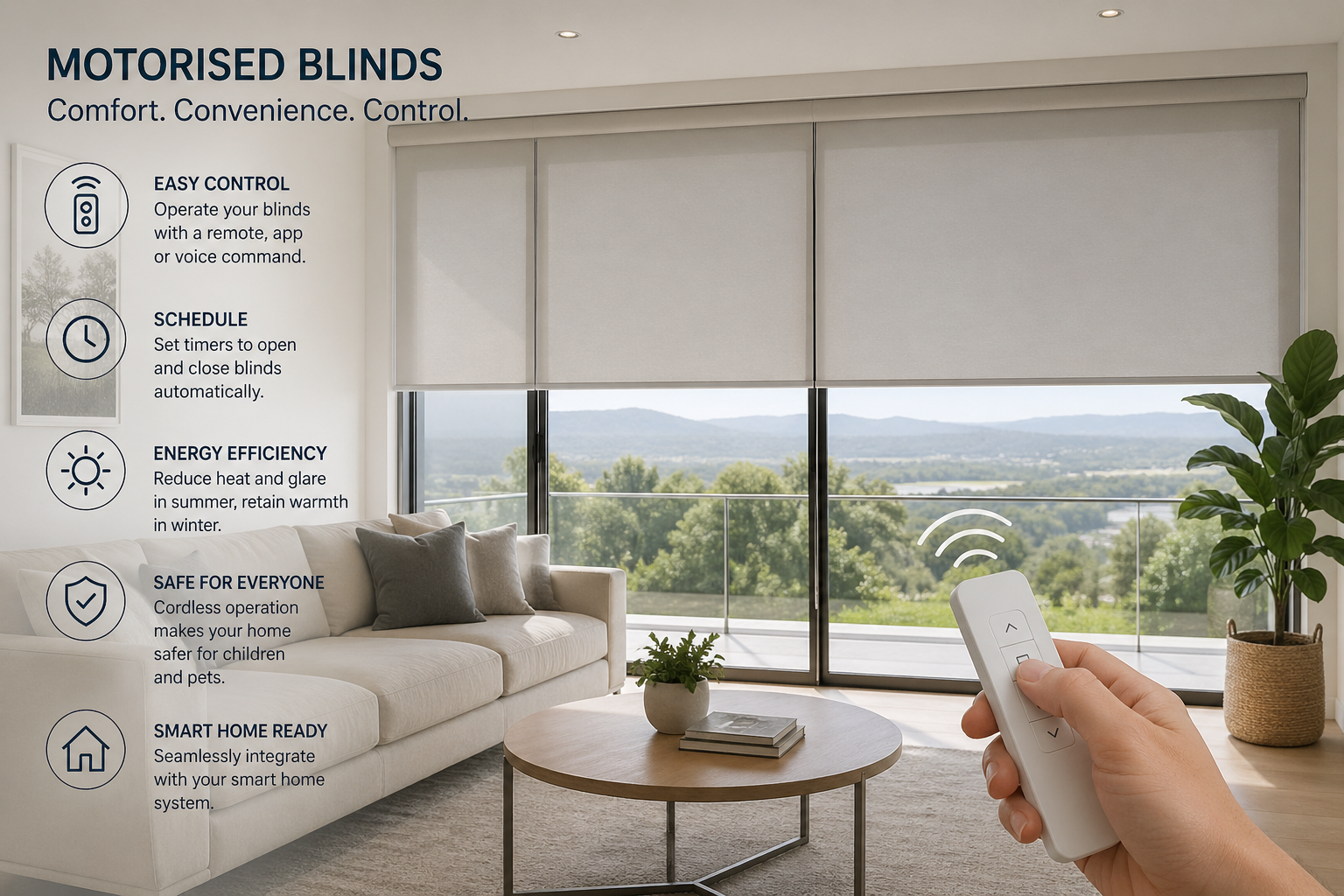
The Sweet Home Blinds motorisation range includes options that can be controlled through compatible remotes, wall switches, applications or automated systems. Not every control method is suitable for every school. The correct arrangement depends on who needs access, how the hall is supervised and whether the system must connect with other building controls.
The value of motorisation is not the number of technological features available. It is the ability to select an operating method that makes the hall easier to manage.
Campbell High School: A Real Canberra Example
The Campbell High School installation is a completed commercial education project in Campbell, ACT.
Somfy motorised blinds were installed throughout the school hall. The system was selected to provide quiet operation suitable for performances, presentations and everyday activities.
This is important because a school hall is not used only before or after an event. Light conditions may need to change while an activity is already underway. A noisy system could distract an audience, interrupt a speaker or become noticeable during a quieter part of a performance.
The project also illustrates the practical relationship between motorisation and scale. When multiple blinds are distributed throughout a hall, centralised or grouped operation can be more appropriate than requiring staff to manage every blind separately.
The published project information does not claim that the blinds provide complete darkness, control the hall’s acoustics or replace the building’s cooling system. Their confirmed role is more specific: they provide motorised light control with quiet operation across a multi-purpose school hall.
Maintaining this distinction is important. The final performance of any blind installation depends on the fabric, dimensions, mounting position, glazing, surrounding gaps and building conditions.
Quiet Operation During Performances and Presentations
Motor noise may be relatively unimportant in a busy common area, but it deserves more attention in a performance or presentation space.
During a musical performance, speech or award ceremony, background noise can be noticeable. If blinds need to move during the event, the motors and track or roller components should operate as unobtrusively as possible.
Quiet operation also supports presentations. A teacher or guest speaker may need to reduce daylight after the audience has entered the room. The adjustment should not become the focus of attention.
At Campbell High School, the Somfy motorised blinds were specifically described as providing whisper-quiet operation suited to performances, presentations and everyday use. This makes the project a relevant example of selecting the operating system according to the room’s actual activities rather than focusing only on window dimensions.
Quiet performance should still be considered alongside speed, load capacity and reliability. A suitable motor must be capable of moving the selected blind safely and consistently. The quietest available motor is not automatically appropriate if it cannot support the product size or expected frequency of operation.
The correct system is the one that balances acoustic expectations with the technical requirements of the installation.
Managing Glare on Projectors and Digital Displays
School halls increasingly rely on digital screens, projectors and presentation equipment. Strong daylight can reduce contrast and make displayed content more difficult to see.
The problem is not always the total amount of light in the room. Glare can result from a bright window positioned within the audience’s field of view or from sunlight reflecting across a screen.
Research into daylight and visual discomfort has shown that the brightness and position of windows influence how people experience glare. Although much of the research examines workplaces, the same visual principle is relevant to presentations in schools.
A blockout or suitably selected light-control blind may reduce incoming light, but the final result depends on the installation. Gaps can remain around the sides of an internally mounted blind, and adjacent windows or doors may continue admitting light.
Motorised operation provides convenience rather than guaranteeing blackout performance. If a hall needs particularly dark conditions, the blind fabric, side coverage, mounting details and every other source of light must be assessed together.
For ordinary presentations, the more useful requirement may be adjustable glare reduction rather than complete darkness. The blinds can be lowered only where needed while other sections remain open to daylight.
Dividing the Hall Into Control Zones
Operating every blind at the same time may be convenient for some activities, but it is not always the most flexible arrangement.
Sunlight may affect one side of the hall before reaching another. A presentation screen may be located near a particular group of windows. A stage may require stronger control while seating areas remain open to daylight.
Dividing blinds into logical control zones can allow staff to respond more precisely. One group may serve the stage, another may cover side windows and another may manage glazing at the rear of the hall.
The exact grouping should follow the window layout and room use. Creating too many separate zones can make the system confusing, while placing every blind into one group may remove useful flexibility.
Control labels should be clear enough for staff who do not use the hall every day. A switch identified only by a technical circuit number may be less helpful than one labelled according to the relevant wall or activity area.
Any all-open or all-close function should also be considered carefully. It may be useful when preparing the room, but authorised users still need a way to make smaller adjustments when conditions vary.
Control zoning should be decided before programming and handover rather than after staff discover that the original grouping does not match how the hall is used.
Wall Switches, Remotes and Building Controls
Different control methods suit different school environments.
A fixed wall switch is difficult to misplace and can be positioned in a supervised area. It may be suitable when staff need simple, repeatable operation without relying on a separate device.
A remote control allows operation from different positions in the hall. This may be helpful during rehearsals or presentations, although storage and access procedures need to be established so the remote remains available to authorised users.
Application-based control may offer additional flexibility, but it also introduces questions about compatible devices, network access, user permissions and future software support.
Connection with a wider building-management or automation system may be appropriate in some projects. This requires early coordination between the blind supplier, electrical contractor, builder and any automation specialist.
Sweet Home Blinds’ article asking whether motorised blinds are worth it explains the general differences between convenient operation, scheduling and grouped control. In a school, these features should be assessed through operational simplicity and staff access rather than residential lifestyle routines.
The most advanced control option is not automatically the most useful. A school hall often benefits from a system that is easy to understand, difficult to misuse and straightforward to support.
Electrical Planning Should Begin Early
Motorised blinds require a suitable source of power. The electrical arrangement depends on the selected motors, window locations and building design.
For a new hall or major refurbishment, the blind layout should be coordinated before the walls and ceilings are completed. This gives the project team more opportunity to position power supplies, control wiring and access points neatly.
Retrofitting motorisation into an existing hall may require a different approach. The team needs to assess whether power can be brought to the windows without creating exposed cabling or interfering with other services.
The motor position should be confirmed before electrical work is finalised. Power installed on the wrong side of the blind can lead to visible cables, additional work or changes to the product specification.
Future access is also important. Concealing every component may create a clean appearance, but motors, connections and control equipment may eventually require inspection or servicing.
Electrical work must be completed by appropriately qualified professionals and coordinated with the window-furnishing system. The blind installer should not be expected to resolve an unsuitable power location after the final finishes are complete.
Early planning protects both the appearance of the hall and the practicality of future maintenance.
Battery or Hardwired Motorisation?
Motorised blinds may use hardwired power, rechargeable batteries or other compatible power arrangements. The right choice depends on the project.
Hardwired systems can suit larger installations where regular operation and long-term integration are important. They avoid the need to recharge individual blind batteries, but they require electrical planning and suitable access.
Battery-powered motors may reduce wiring requirements in some retrofit situations. However, a school needs a realistic charging and maintenance plan. A battery that is difficult to reach or repeatedly forgotten can undermine the convenience motorisation was intended to provide.
The number and height of the blinds matter. Recharging one accessible residential blind is different from maintaining multiple units across a large school hall.
Operating frequency also affects the decision. Blinds that move several times each day may have different power requirements from blinds adjusted only for occasional performances.
No power type is automatically superior. The school should compare installation constraints, expected use, access, maintenance responsibilities and manufacturer requirements before selection.
Sweet Home Blinds’ guide to battery motors for blinds and curtains provides an introduction to battery operation, but a commercial education project requires a site-specific assessment.
Safety Around Students
Safety must be addressed during product selection, installation and everyday operation.
Motorised blinds can remove the need for some manual chains or accessible operating cords, depending on the selected system. This may create a cleaner operating arrangement in a space used by students.
However, motorisation should not be treated as a complete safety assessment. The blind, electrical components, controls, mounting points and surrounding furniture still need to suit the environment.
Product Safety Australia warns that unsecured blind and curtain cords can create a strangulation hazard for children. Its blinds, curtains and window fittings guide advises consumers to choose compliant products and keep loose or looped cords secured and out of children’s reach.
The mandatory requirements discussed by Product Safety Australia primarily address corded internal window coverings and their installation. A commercial school project may involve additional building, electrical, procurement and workplace requirements that need to be reviewed by the responsible project professionals.
Control access should also be considered. Students should not be able to repeatedly operate the blinds without supervision, particularly where movement could be obstructed.
The safest result comes from treating motorisation as part of the complete room rather than assuming that the absence of a manual chain resolves every risk.
Protecting the Blinds From Obstruction
Motorised blinds need a clear travel path. Furniture, stage equipment, decorations and temporary displays should not be placed where they can obstruct the fabric or bottom rail.
School halls change frequently. Chairs may be rearranged, performance equipment may be moved near the windows and event displays may be installed temporarily. An area that was clear during installation may later become blocked.
Staff should know that the blinds must not be operated against an object. A motor may continue attempting to move the blind even when fabric or hardware has become caught, depending on the system and its protective features.
Nothing should be attached to the blind fabric or bottom rail unless the manufacturer and installer have approved it. Decorations, signs and event materials can change the load or interfere with movement.
Visual checks are especially important after the hall has been prepared for an event. Before operating a large group, staff should confirm that the path is clear.
Where furniture regularly sits near the windows, floor markings or operational guidance may help preserve suitable clearance.
Selecting the Right Blind Fabric
Motorisation controls movement, but the fabric determines much of the blind’s light and privacy performance.
A sunscreen fabric may reduce glare while retaining some daytime visibility. A light-filtering fabric can diffuse daylight and create a softer effect. A blockout fabric provides stronger coverage through the main material area.
The correct choice depends on the hall’s orientation and activities. A space used mainly for assemblies may not need the same darkness as a hall regularly used for projected performances.
Fabric colour also affects the result. Dark and light fabrics can behave differently in terms of view-through, glare, visible contrast and interior appearance.
Durability and cleaning requirements matter in a school. The fabric should suit the expected environment and be maintained according to the manufacturer’s instructions.
Sweet Home Blinds’ roller blind collection includes blockout, light-filtering and sunscreen fabrics with manual and motorised operating options. The final combination must still be confirmed according to the opening dimensions and selected motor system.
No fabric should be described as creating total room darkness without considering edge gaps and other openings. The complete installation determines the final result.
Can Motorised Blinds Improve Thermal Comfort?
Internal blinds can help manage direct sunlight and reduce exposure to the glass, but they form only one part of the building’s thermal design.
The Australian Government’s Your Home glazing guide explains that window furnishings can improve the overall thermal performance of window systems. It also notes that glazing, frames, orientation and air leakage influence the final result.
During warmer conditions, closing blinds before strong sunlight reaches the hall may help reduce glare and some solar effects inside the room. However, internal blinds operate after sunlight has already passed through the glass.
The government’s window-shading guidance explains that appropriate external shading is generally more effective at preventing unwanted summer heat from reaching glazing.
In winter, permanently closed blinds may remove useful daylight and solar warmth. Adjustable operation allows the school to respond to current conditions instead of applying one setting throughout the year.
Motorised blinds should not be presented as a substitute for efficient glazing, insulation, ventilation or appropriate heating and cooling. Their role is to provide controllable internal coverage as part of the wider building system.
Installation Access in a School Hall
School halls often contain high windows, stages, tiered seating or fixed equipment. These features can make measurement and installation more complicated than work in a standard room.
The installation team may require elevated access equipment. Floor protection, safe working areas and separation from students need to be organised before work begins.
The timing should fit the school’s operating calendar. Installation may need to occur outside teaching hours, during a scheduled closure or in carefully controlled stages.
Existing services must be identified. Lighting, sprinklers, acoustic panels, structural beams and ventilation outlets may affect the available mounting position.
Mounting surfaces need adequate support for the blind and motor. The installation should not rely on an unsuitable surface simply because it is convenient to reach.
Access arrangements also matter after completion. If a motor or control component needs future attention, maintenance personnel should be able to reach it without dismantling unrelated building elements.
These considerations should be documented during the site assessment rather than left for the installation day.
Programming and Handover
A motorised blind installation is not complete when the physical products have been fitted. The controls need to be programmed, tested and explained to the people responsible for the hall.
Each blind should move in the correct direction and stop at suitable limits. Group controls should operate only the intended windows. If scenes or preset positions are included, they should reflect activities the school actually uses.
Clear labels can reduce confusion. Staff should be able to identify which control operates the stage, side wall or entire hall without trial and error.
Handover should explain ordinary operation, emergency stopping, obstruction checks and who to contact if a blind behaves unexpectedly.
The school should also decide who is permitted to change programming or add new controllers. Uncontrolled changes can result in lost settings or inconsistent operation.
Basic information should remain available even when staff roles change. A system known only to one employee may become difficult to manage when that person is absent or leaves the school.
The operating guide does not need to be complicated. It needs to be accurate, accessible and specific to the installed system.
Maintenance and Long-Term Reliability
Motorised blinds reduce manual handling, but they are not maintenance-free.
Fabric may collect dust, particularly in a large multi-purpose space. Cleaning should follow the supplier’s instructions, using methods suitable for the selected material.
The blind should be observed during normal operation. Uneven movement, unusual noise, fabric tracking problems or changing stop positions may indicate that inspection is required.
Electrical and motor components should only be serviced by appropriately qualified or authorised personnel. Staff should not attempt to dismantle a motor housing or adjust internal electrical connections.
A maintenance record can be useful in a school installation containing multiple blinds. The record can identify which unit was inspected, what problem was reported and what work was completed.
Product references, motor models, control information and programming notes should be retained after handover. These records can make future servicing or replacement more efficient.
Sweet Home Blinds provides general care and maintenance information, although the instructions supplied for the specific blind, fabric and motor should always take priority.
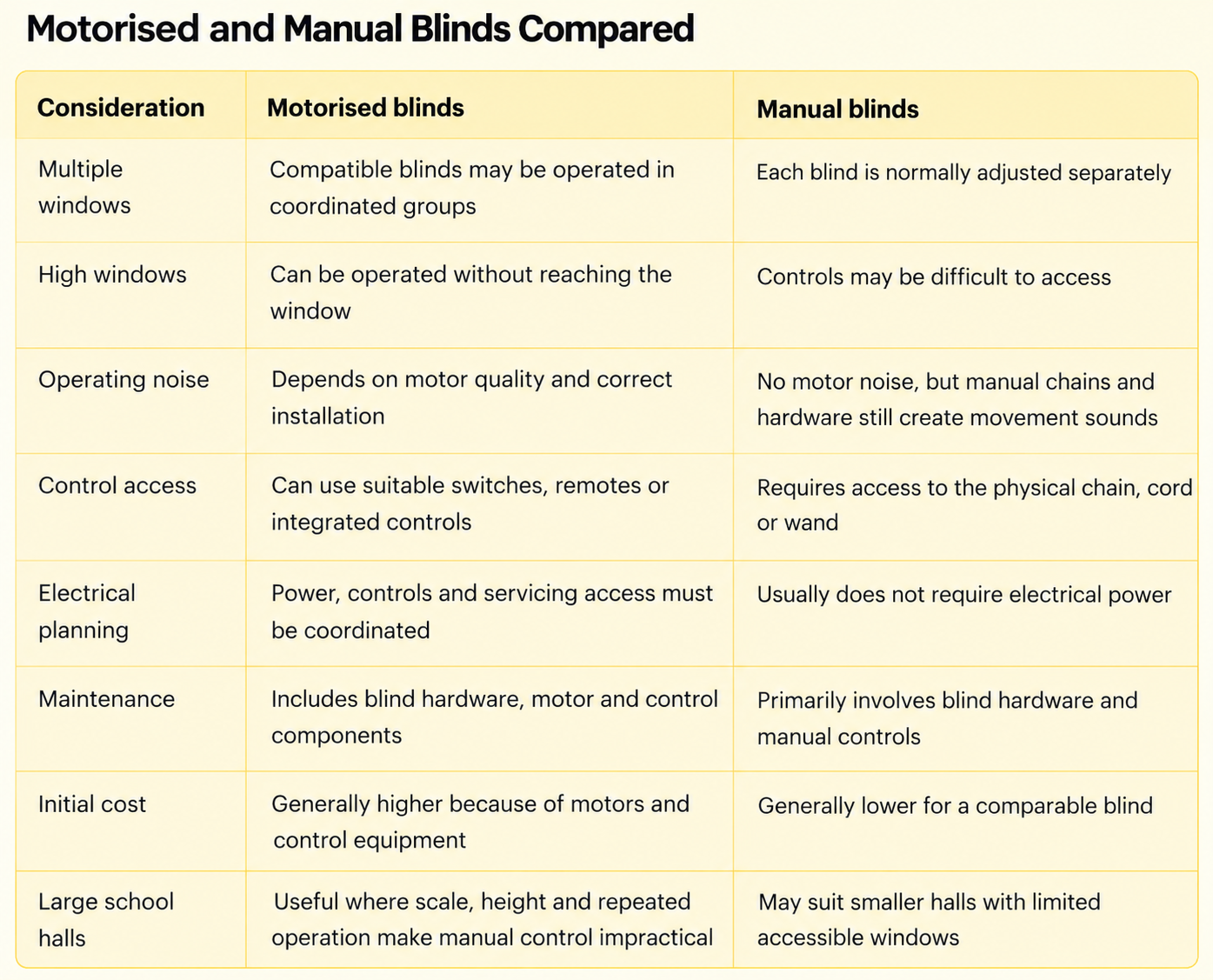
Motorised and Manual Blinds Compared
Is Motorisation Worth the Additional Cost?
Motorised blinds generally cost more than comparable manual products. The project includes motors, controls, electrical coordination and additional testing.
The value should therefore be assessed through operation rather than novelty.
If a hall contains only a few accessible windows and the blinds rarely move, manual operation may remain practical. Motorisation may offer limited benefit in that situation.
The comparison changes when windows are high, blinds are numerous or lighting conditions need to change regularly. Staff time, access equipment, consistency and ease of operation become more important.
Quiet control may add further value in a performance space. At Campbell High School, the suitability of the motorised system for performances and presentations formed part of the project’s practical outcome.
Long-term responsibilities should be included in the cost assessment. The school needs a plan for servicing, replacement controls, electrical support and any battery maintenance.
The lowest initial price does not always create the lowest whole-of-life cost. At the same time, adding automation features that staff will not use may provide poor value. The specification should remain proportionate to the hall.
Frequently Asked Questions
Are motorised blinds suitable for school halls?
Yes. They can be useful when a hall contains multiple, large or difficult-to-reach windows and needs flexible light control for different activities.
Are motorised blinds completely silent?
No motor is literally silent. Noise levels vary according to the motor, blind size, installation and surrounding acoustics. A quiet system should be selected when blinds may move during performances or presentations.
Can all the blinds operate together?
Compatible blinds can often be arranged into groups, but the available functions depend on the selected system and programming.
Do motorised blinds provide complete blackout?
Not automatically. The fabric may provide strong light control, but gaps can remain around the sides, top or bottom. Other windows and doors may also admit light.
Do motorised blinds need electricity?
Yes. They require a compatible power source, which may be hardwired, battery-based or another approved arrangement depending on the system.
Are motorised blinds safer around students?
They may remove the need for certain accessible manual cords or chains, but the complete installation still requires a proper safety assessment.
Can staff control different parts of the hall separately?
Yes, if the blinds and controls are configured into suitable zones. The required groups should be planned before programming.
Can existing school-hall blinds be motorised?
Sometimes, but not every existing blind is suitable for conversion. The product, size, condition, mounting and access to power need to be assessed.
How often do motorised blinds need servicing?
There is no universal interval for every system. The school should follow the manufacturer’s guidance and arrange inspection if operation becomes uneven, noisy or unreliable.
Who should operate the blinds?
The school should define authorised users and provide clear operating instructions. Controls should be stored or positioned where they can be accessed by staff without encouraging unsupervised use.
Planning Motorised Blinds for an Education Project
Motorised blinds can make a school hall easier to adapt throughout the day. They can support natural daylight during general use, reduce glare for presentations and provide quieter adjustment during performances.
The result depends on more than selecting a motor. The project team needs to consider blind fabric, window orientation, operating noise, control zones, power, mounting support, student safety and future maintenance.
Campbell High School provides a completed Canberra example. Somfy motorised blinds were installed throughout the hall to provide quiet operation for performances, presentations and everyday use. The project demonstrates a clear reason for motorisation: the control system responds to the scale and varied activities of the space.
Other schools may require different fabrics, controls or power arrangements. These decisions should be made after the windows and hall operation have been assessed rather than copied directly from a residential specification.
Explore Sweet Home Blinds’ motorised window-furnishing options, review more commercial and education projects, or visit the complete Sweet Home Blinds blog for additional guidance about blind fabrics, automation and light control.
Planning motorised blinds for a Canberra school, hall or multi-purpose facility? Book a consultation with Sweet Home Blinds to discuss site measurement, motor selection, control planning and professional installation.
Follow Sweet Home Blinds on Facebook and Instagram for completed Canberra installations and window-furnishing inspiration.