
Roller Blinds for Canberra Investment Properties
Learn how to choose roller blinds for Canberra investment properties, including fabric selection, privacy, maintenance, tenant use, safety, replacement planning and real local projects.
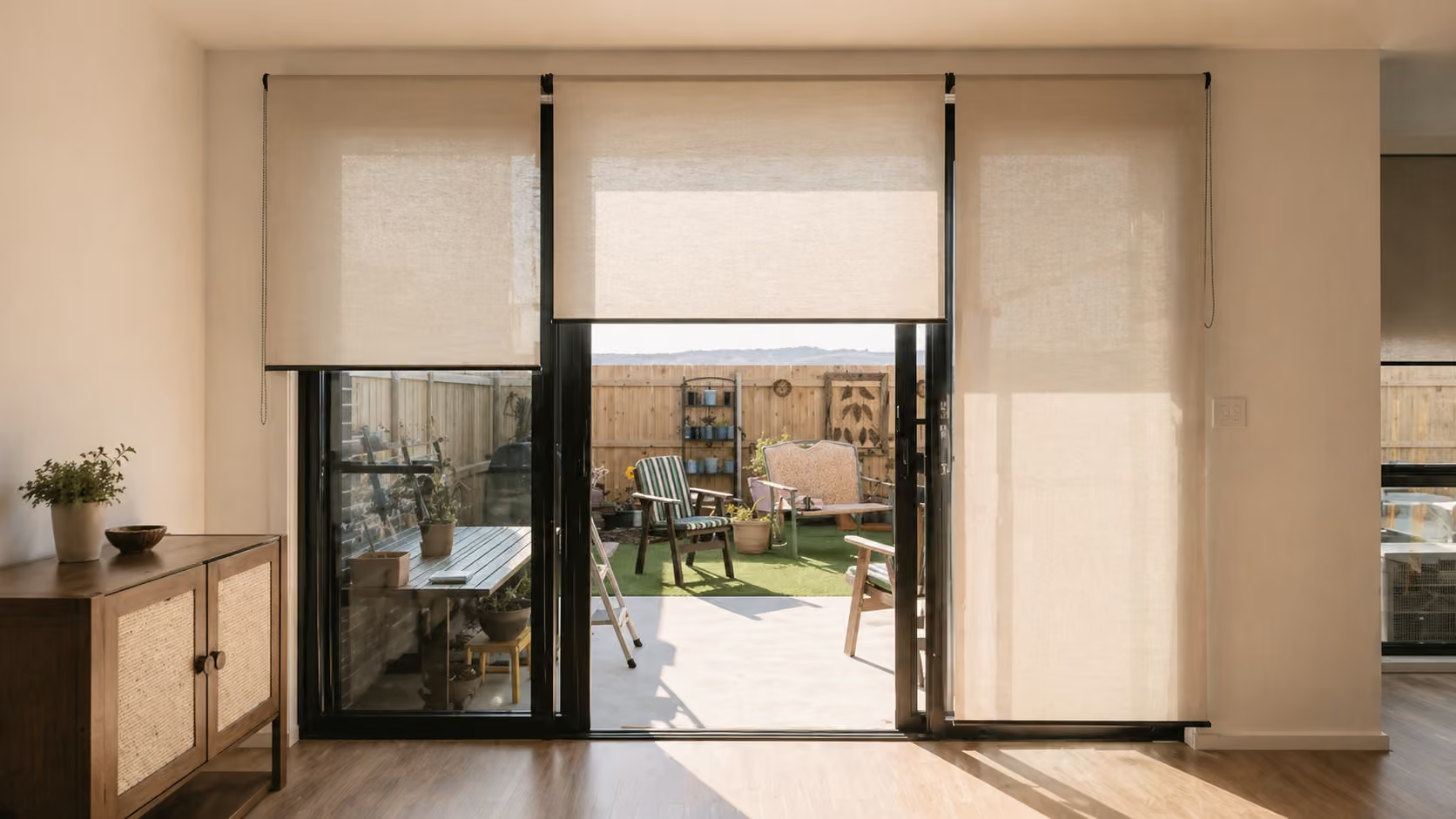
Window furnishings in an investment property need to look presentable, provide practical privacy and remain straightforward for tenants to operate. They must also be suitable for the room, correctly measured and manageable when cleaning, maintenance or replacement becomes necessary.
Roller blinds are commonly considered for this type of property because they have a compact design, a relatively simple operating system and a clean appearance that works with many interiors. Different fabrics can provide blockout, light-filtering or sunscreen performance without changing the basic structure of the blind.
However, selecting roller blinds for a rental property involves more than choosing a neutral colour and covering every window with the same fabric. Bedrooms, living areas and bathrooms have different requirements. Window orientation, privacy, furniture placement, control safety and maintenance access must also be considered.
The Denman Prospect Boulevard project provides a direct Canberra investment-property example. Roller blinds were selected to provide privacy, reliable everyday light control, clean lines and a neat, low-maintenance finish.
The Turner Townhouse offers another residential example of roller blinds used for practical privacy and flexible light control. At a larger scale, WOVA Towers demonstrates how commercial-grade blinds can provide a consistent finish across a high-rise residential development.
Together, these projects show why roller blinds can suit different forms of investment housing when the fabric, measurements and installation are planned properly.
Why Roller Blinds Suit Many Investment Properties
An investment-property window furnishing usually needs to satisfy several people over its life. The owner wants a durable and cost-effective result. The property manager needs a product that can be inspected and maintained. Tenants need privacy, light control and uncomplicated daily operation.
Roller blinds provide a relatively direct response to these requirements. The fabric moves vertically around a tube and stays close to the window. It does not require the floor area or large fabric stack associated with full-length curtains.
Their simple appearance can also suit changing furniture and decorating styles. A neutral blind does not depend on one tenant’s colour scheme and can remain visually appropriate when the property is re-leased.
Roller blinds can be used across bedrooms, living rooms, studies and selected utility areas. The product format remains consistent, while the fabric changes according to the room.
This makes it possible to create a coordinated whole-property result without using identical performance specifications at every window.
The benefit is not that roller blinds are maintenance-free. Fabric can still collect dust, chains and brackets require correct use, and components can be damaged if they are forced. Their advantage is that the basic system is familiar, compact and relatively easy to understand.
Beginning With the Needs of Each Room
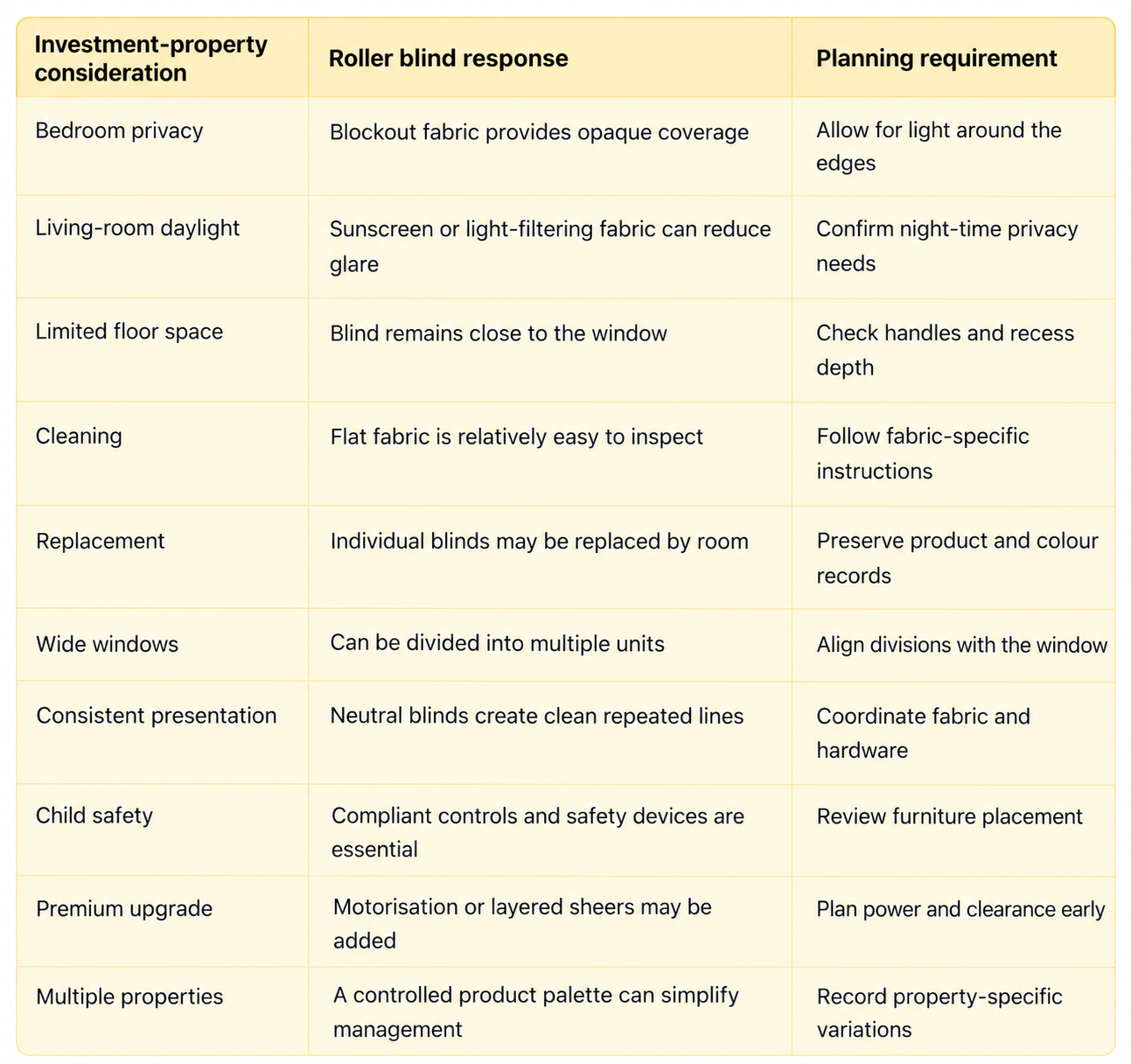
Using the same blockout fabric across an entire property may simplify ordering, but it can produce unnecessary darkness in living areas. Using sunscreen fabric everywhere can create night-time privacy problems in bedrooms.
A more practical specification assigns the fabric according to room function.
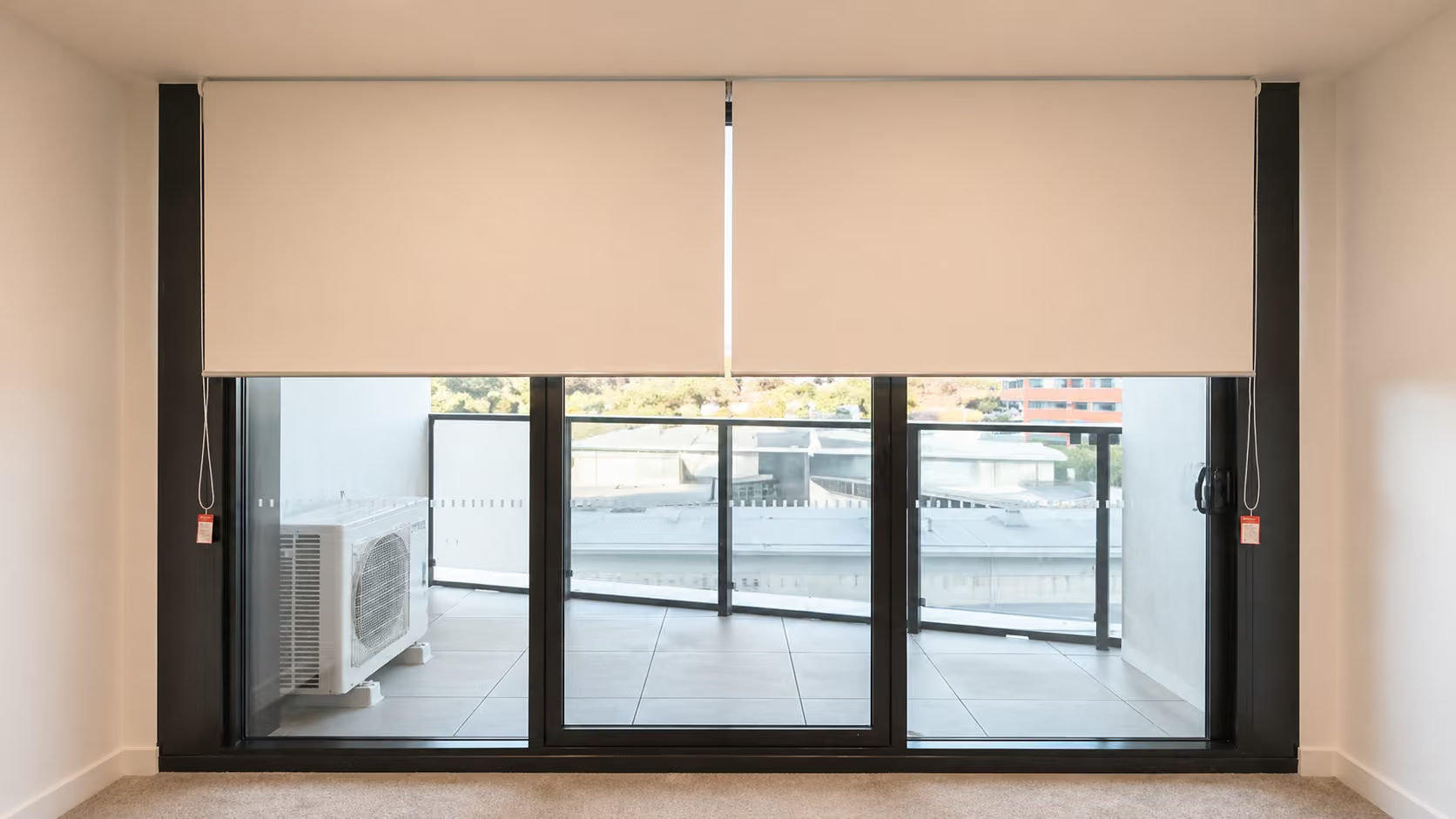
Bedrooms generally need opaque coverage after dark and better control over early sunlight. Blockout roller blinds are often the logical starting point.
Living rooms may benefit from light-filtering or sunscreen fabrics that reduce glare while preserving a brighter daytime atmosphere. An additional privacy layer may still be required, depending on the property’s location.
A home office or study needs glare control around computer screens. The blind should manage direct brightness without making the room unnecessarily dark.
Bathrooms, laundries and kitchens require materials suited to the conditions. Moisture, splashes and cleaning needs should be discussed before the fabric is selected.
Sliding doors and very wide windows require additional planning because one large blind may not be the most practical configuration.
This room-based approach keeps the overall design consistent while giving tenants the type of coverage they need in each part of the property.
Blockout Roller Blinds for Bedrooms
A rental bedroom needs reliable visual privacy after dark. It should also allow tenants to reduce early morning light, particularly where the window faces east or receives strong street lighting.
Blockout roller-blind fabric provides opaque coverage across the main window area. It generally creates a darker room than sunscreen or light-filtering fabric.
The word “blockout” describes the fabric, not the complete installation. Light may still enter around the sides, above the blind or below the bottom rail. An inside-mounted blind can leave more visible edge light because the fabric must remain narrower than the recess.
An outside-mounted blind may provide wider coverage, but its brackets and fabric need enough wall space. Window architraves, handles and surrounding furniture must also be considered.
A blind should not automatically be advertised as providing complete darkness. Tenants with specific sleep requirements may still prefer curtains or a layered system.
For a standard investment property, blockout roller blinds can provide a practical balance between privacy, room darkening, compact installation and straightforward operation.
The final result depends on accurate measurement and the relationship between the blind, frame and surrounding wall.
Living Rooms: Sunscreen, Light Filtering or Blockout?
Living rooms usually need a more flexible balance between privacy and natural light.
Sunscreen fabric uses an open weave that can reduce glare and preserve some daytime outward visibility. It may suit an upper-level apartment or a living room with an attractive view.
Sunscreen blinds should not be treated as dependable night-time privacy. When the interior is brightly lit and the exterior is dark, people outside may be able to see into the room more easily.
Light-filtering fabric softens daylight without providing a clear view through the material. It can create a brighter and more diffuse result than blockout fabric while offering greater visual coverage than some sunscreen options.
Blockout fabric provides the strongest opaque coverage but removes more daylight and the external view when closed. It may suit a ground-floor living room facing a busy path or neighbouring property.
Double roller blinds can combine two fabrics, such as sunscreen and blockout. This gives tenants more control but requires additional mounting space and introduces more hardware.
For many investment properties, the decision depends on what the window faces. A high-level window overlooking open space may suit sunscreen fabric. A ground-floor window close to a shared driveway may require a more private material.
Street-Facing and Ground-Floor Privacy
Ground-floor rentals can be challenging because pedestrians, neighbours or residents using common areas may pass close to the windows.
A blockout blind provides strong privacy when closed, but it also removes natural light. Tenants may keep the blind closed throughout the day if no other privacy setting is available.
A light-filtering blind can provide softer coverage while allowing the room to remain brighter. The degree of privacy still depends on the fabric and lighting conditions.
Double roller blinds provide another option. A sunscreen layer can manage daytime visibility and glare, while a blockout layer provides stronger night-time privacy.
The additional layer increases cost and requires a deeper recess or more wall projection. Both blinds also need to clear handles and opening sections.
The correct solution should be determined by viewing the property from outside as well as inside. A fabric sample that appears private in a showroom may behave differently on a brightly lit ground-floor window.
Street lighting can also affect the result. A window directly opposite a bright exterior light may require different coverage from a shaded upper-level opening.
Privacy should therefore be assessed as part of the measure rather than assumed from the fabric name.
Roller Blinds Around Sliding Doors
Investment properties often contain sliding glass doors leading to a balcony, courtyard or small garden. These openings need privacy and glare control without making access inconvenient.
A roller blind may cover a fixed glass panel, but its position must not interfere with the active door, handle or frame.
Where the opening is wide, several blinds may be required. Dividing the blinds according to the door and window panels can allow tenants to open the section they need without raising every blind.
Separate blinds can create small light gaps between the fabrics. This may be acceptable in a living room but should be considered before ordering.
The blind’s bottom rail must also clear handles and projecting hardware. If the blind moves against the handle, repeated contact can mark the fabric or affect operation.
Manual controls should remain easy to reach. A chain positioned behind a large sofa or dining table may be difficult for tenants to use and can encourage them to pull the fabric instead.
Where very frequent door access is expected, curtains, vertical blinds, Veri Shades or another suitable product may be worth comparing. Roller blinds should be selected because they suit the opening, not simply because they are used elsewhere in the property.
Choosing Neutral Colours Without Making the Property Feel Generic
Neutral colours are commonly selected for investment properties because they can suit a wide range of furniture and interior styles.
White, off-white, beige and soft grey fabrics can relate to common wall colours and window frames. They also reduce the risk that the blind becomes a dominant feature during property photography or inspections.
Neutral does not mean that every component must be bright white. A stark fabric may create strong contrast against warm paint, timber floors or dark frames.
The fabric should be viewed beside the actual wall, flooring and frame colours. Samples can behave differently under natural and artificial light.
Exterior appearance should also be considered, particularly in apartments, townhouses and developments with visible façades. A consistent external fabric colour may be required by the building or owners corporation.
Hardware colours, brackets, chains and bottom rails contribute to the finish. Coordinating these elements can make a simple roller blind look more intentional.
The Denman Prospect Boulevard project demonstrates the value of a restrained result. The blinds were selected for practical privacy and light control while maintaining clean lines and a neat, low-maintenance appearance.
Practicality Does Not Mean Choosing the Cheapest Blind
A low initial purchase price does not automatically provide better investment value.
An inexpensive ready-made blind may not fit the window correctly. Excessive gaps can reduce privacy and room darkening, while unsuitable brackets may conflict with handles or opening sections.
Standard sizes may also require compromises in width or drop. A blind that is too narrow can expose more glass, while one that is too wide may not fit inside the recess.
Custom roller blinds are measured for the specific opening and selected configuration. This allows the installer to consider the frame, architrave, controls and surrounding area.
Material and hardware quality also affect the experience. A poorly balanced blind may be difficult to raise, while a weak operating system can be damaged by repeated use.
Investment value should be considered over the period the product is expected to remain in the property. A blind that fits correctly, operates smoothly and has identifiable components may be easier to maintain than a cheaper product that requires early replacement.
Owners should compare the complete installed result rather than only the price of the fabric.
Durability in a Frequently Used Rental Property
No internal window furnishing is immune to damage. Roller blinds can be affected by rough handling, furniture contact, moisture, dirt and incorrect operation.
The fabric should be raised and lowered using the supplied control. Pulling directly on the bottom rail or fabric can cause the blind to roll unevenly.
Furniture placement matters. A sofa, bed or desk pressed against the fabric can mark it and prevent the blind from hanging freely.
Windows that are opened frequently may expose the blind to wind. A blind should not be left lowered against an open window where strong airflow can move it repeatedly against the frame.
Bathrooms and kitchens require suitable material selection. A general living-room fabric should not automatically be assumed to suit moisture or cooking residue.
Control systems should also match the window size. A wide or heavy blind needs suitable hardware to support comfortable operation.
Durability begins with correct specification and installation. Tenant instructions and reasonable maintenance can then help the product remain functional.
Cleaning Between Tenancies
A window furnishing that can be inspected and cleaned without complicated removal is useful during a change of tenancy.
Roller blinds use a flat fabric panel, which makes both sides easier to view than heavily folded curtains. Dust and marks can still collect on the fabric, bottom rail and hardware.
Routine care may involve gentle dusting or vacuuming with a soft brush attachment, depending on the selected material. Cleaning instructions vary, so the supplier’s guidance should be followed.
Strong chemicals, abrasive sponges and excessive water can damage coatings, alter fabric colour or leave visible marks.
The blind should not be rolled up while wet. Moisture trapped between layers can affect the fabric.
Property managers should also inspect the controls, chain tensioner, brackets and bottom rail. A blind that operates unevenly may need adjustment rather than aggressive pulling.
Sweet Home Blinds provides general care and maintenance information, but the instructions for the installed fabric and system should take priority.
Providing these instructions in the tenant handover information can reduce accidental damage caused by unsuitable cleaning methods.
Recording the Product Specification
Replacing a damaged blind is easier when the original product information has been preserved.
The property file should identify the room, window, fabric range, colour, blind type, control side, mounting method and approximate installation date.
Photographs taken after installation can also help establish how the blind should sit and which hardware was supplied.
Without these records, an owner may need to identify an old fabric from appearance alone. Colours can fade slightly over time, and product ranges may change.
If several properties use the same specification, clear records make future ordering more efficient. This can be useful for owners, builders or property managers responsible for multiple residences.
A consistent naming system can identify each opening, such as main bedroom window, living-room door or study window. This avoids confusion when several blinds have similar dimensions.
The WOVA Towers project demonstrates the broader importance of consistency in a large residential installation. Commercial-grade blinds were installed across the high-rise development to deliver coordinated window treatments throughout the project.
The project should not be presented as proof that every residence is a rental property. Its value here is as an example of organised, consistent blind installation across many homes.
When One Roller Blind Is Too Wide
Large windows can create engineering and operational limits. A blind that appears simple on a plan may become heavy when manufactured as one wide unit.
Dividing the window into multiple blinds can reduce the size of each unit and allow more flexible operation. The divisions should usually relate to the window mullions or door panels.
Poorly planned divisions can create unnecessary gaps or place controls in awkward positions.
Fabric width, tube size, weight and drop all influence the suitable configuration. The answer should be determined during professional measurement rather than assumed from the glass dimensions.
The way tenants use the room also matters. Separate blinds allow one part of the window to remain open while another section provides glare control.
However, several controls can appear visually busy. Motorisation or grouped control may be considered for larger or premium properties, although this introduces additional cost and maintenance requirements.
The best arrangement balances operation, appearance and the physical limitations of the product.
Manual Controls or Motorisation?
Manual roller blinds are familiar and may be sufficient for standard windows that are easy to reach.
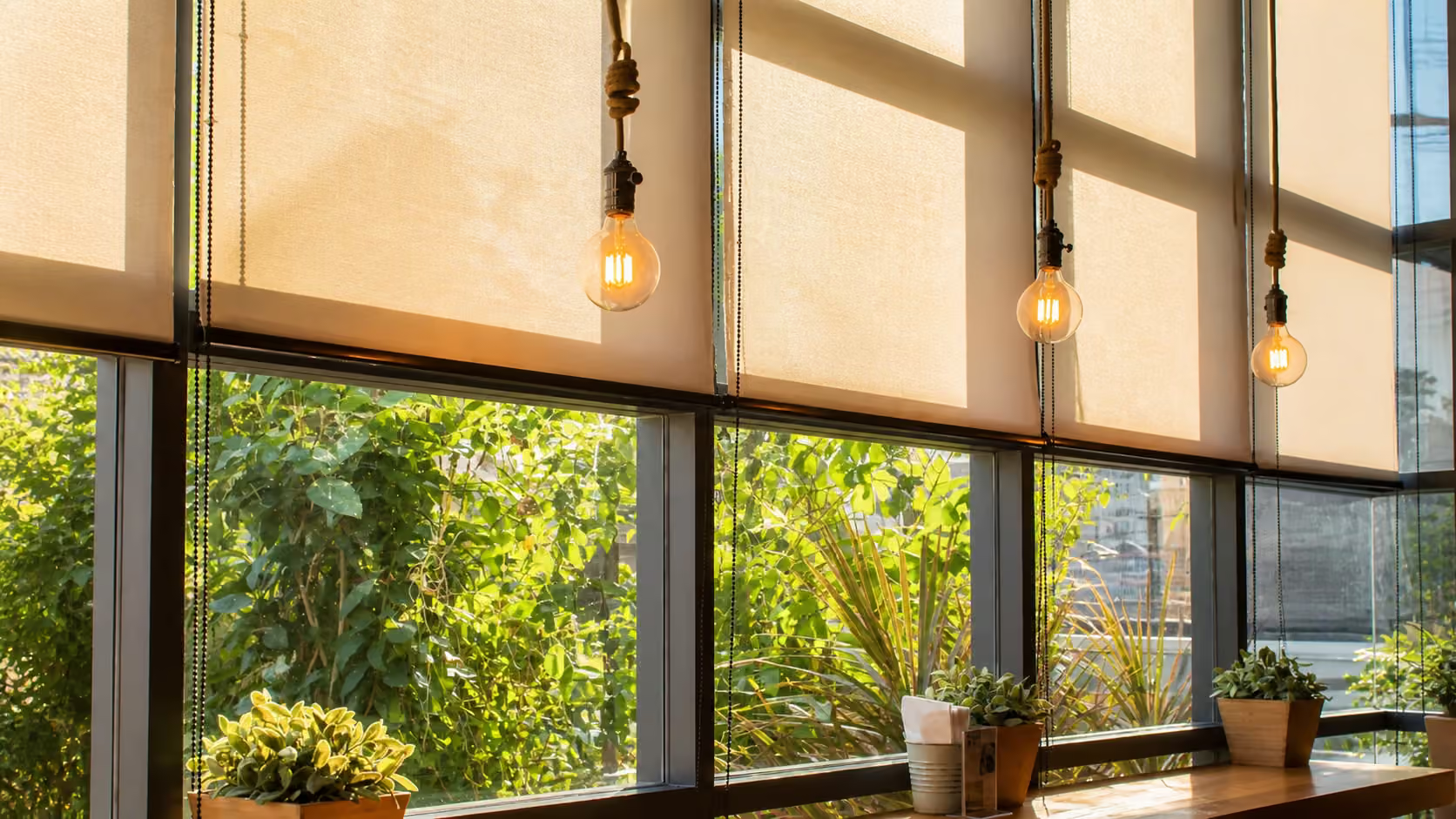
Motorisation can be useful for large, high or inaccessible windows. It may also suit premium apartments and properties where several blinds need to operate together.
Battery-powered and hardwired systems have different requirements. Hardwired motorisation needs early electrical planning, while battery systems require future charging or battery replacement.
Motorised controls must remain with the property and be clearly identified. Remote controls can be lost during a tenancy, so the handover and exit inspection processes should account for them.
Owners should also retain programming and warranty information. A future property manager or service technician will need to know the motor and control system used.
Motorisation should solve a practical problem or support the positioning of the property. Adding it to every small and accessible blind may create unnecessary cost.
For standard investment properties, reliable manual operation may offer the simpler approach. For difficult or high glazing, motorisation may improve usability and reduce unsafe reaching.
Child Safety and Compliant Installation
Corded window furnishings require careful installation and ongoing attention.
Product Safety Australia’s mandatory standard for blinds, curtains and window fittings includes requirements for the supply and installation of corded internal window coverings.
Safety devices and warning labels form part of the installed product. They should not be removed during cleaning, painting or tenancy changes.
Accessible cords and chains should be secured away from beds, cots, chairs and other furniture that children could climb.
Owners and property managers should inspect safety devices during routine property checks. If a device is loose, damaged or missing, it should be assessed rather than ignored.
Furniture arrangements can change between tenancies. A control that was initially positioned away from a bed may become accessible after the room is rearranged.
Cordless or motorised systems may be considered where appropriate, but the complete product still needs to be installed and used according to its instructions.
Safety should be resolved during selection and measurement rather than treated as an accessory added after installation.
Light, Heat and Canberra’s Seasonal Conditions
Canberra investment properties need to remain practical through cold winters and periods of strong summer sunlight.
Roller blinds can reduce glare and direct exposure to the window, but their effect depends on the fabric and installation. Gaps around the blind allow air movement and light to remain.
The Australian Government’s Your Home glazing guide explains that blinds and curtains can improve the overall thermal performance of window systems. It also makes clear that glazing, frames, orientation, sealing and shading all affect the result.
A blockout fabric may provide more substantial coverage than an open sunscreen fabric. However, the blind cannot repair draughty frames or replace efficient glazing and insulation.
Internal blinds manage sunlight after it has passed through the glass. Appropriate external shading can be more effective at reducing unwanted summer heat before it reaches the window.
Tenant behaviour also influences performance. Opening blinds to useful winter sunlight and closing them before evening temperatures fall may improve comfort near the glass.
A west-facing room may need stronger afternoon glare control than a south-facing bedroom. Fabric selection should therefore respond to orientation rather than relying on one universal claim about thermal performance.
Preparing the Property for Photography and Leasing
Window furnishings affect how a property appears in listing photographs and during inspections.
Consistent blinds create cleaner lines across the rooms. Neutral fabrics allow potential tenants to focus on the space rather than an overly personal decorative style.
The blinds should be checked before photography. Uneven bottom rails, twisted chains or damaged fabric can make an otherwise well-presented room appear poorly maintained.
The amount of daylight should also be considered. Fully closing blockout blinds may make the room look smaller, while leaving every blind completely open can expose neighbouring buildings or create glare in the photographs.
A controlled position can show both the natural light and the window furnishing.
In occupied properties, tenant privacy and access requirements must still be respected. The photographic appearance should not take priority over proper notice and agreed access arrangements.
A professionally fitted blind can support the presentation of the property, but it should also remain practical after the photography is complete.
Standardising Blinds Across Multiple Properties
Owners with several investment properties may benefit from using a controlled blind specification.
Standardising a neutral fabric, hardware finish and operating system can simplify future replacement and maintenance. Property managers can more easily identify the product, and installers have clearer information when attending a different property.
Complete standardisation is not always appropriate. Window sizes, orientation and room conditions can vary considerably.
A better approach is to create a small approved palette. This might include a blockout bedroom fabric, a suitable living-area fabric and an alternative material for utility rooms.
The external-facing colour can remain consistent while the internal performance changes.
Records should identify any property-specific exceptions. A west-facing living room may use a different fabric from other rooms, while a high window may require motorisation.
The goal is controlled consistency, not forcing an unsuitable product onto every opening.
The high-rise installation at WOVA Towers demonstrates how consistent blind selection and organised project delivery can support a coordinated result across many residences.
Roller Blinds Compared With Curtains
Curtains can also suit investment properties, particularly where the owner wants a softer or more premium interior finish.
They can extend beyond the window frame and provide broad coverage. However, curtains use more fabric, require stacking space and may need specialised cleaning.
Roller blinds remain closer to the window and can be easier to include behind furniture. Their simple form may also be easier to reproduce across different rooms.
Curtains are not automatically impractical, and roller blinds are not automatically durable. The selected material, hardware and installation quality influence both products.
A premium rental may benefit from sheers in the living area and roller blinds in bedrooms. A compact apartment may use blinds throughout to preserve wall and floor space.
The comparison should consider the property’s market position and architecture rather than assuming every investment needs the lowest-cost product.
Three Relevant Canberra Project Examples
The Denman Prospect Boulevard project is the most direct investment-property example. Roller blinds were selected to provide practical privacy, clean lines, reliable light control and a low-maintenance finish.
The project demonstrates why a restrained roller-blind specification can suit a rental property. The blinds support everyday use without introducing unnecessary visual complexity.
The Turner Townhouse is a residential townhouse example rather than a stated investment property. Its roller blinds demonstrate the same practical qualities: privacy, flexible light control and a clean appearance.
The WOVA Towers project is a high-rise development example. Commercial-grade blinds were installed across the development to create consistent, high-quality window treatments.
Neither Turner Townhouse nor WOVA Towers should be described as confirmed rental projects unless separate evidence establishes that use. Their value is to demonstrate how roller blinds can work in a townhouse and across a large residential development.
Together, the three projects show different scales of application: one identified investment property, one individual townhouse and one high-rise project.
Frequently Asked Questions
Are roller blinds suitable for rental properties?
Yes. They provide a compact, neutral and practical window treatment when the correct fabric, controls and dimensions are selected.
Should every room use blockout fabric?
Not necessarily. Bedrooms usually benefit from blockout coverage, while living areas may suit sunscreen or light-filtering fabric. Privacy and orientation should guide the choice.
Do blockout roller blinds make a bedroom completely dark?
No. The fabric is opaque, but light may enter around the sides, top or bottom of the blind.
Are sunscreen blinds private at night?
They should not be relied upon for dependable night-time privacy. Visibility changes when the inside of the property is brighter than outside.
Are custom blinds better than ready-made blinds for a rental?
Custom blinds are measured for the specific window and can provide better alignment, operation and coverage. The best value depends on the property and expected result.
Which roller-blind colour is best for an investment property?
Neutral colours are usually flexible, but the fabric should be checked against the wall, flooring and window-frame colours.
Can damaged roller-blind fabric be replaced?
Replacement options depend on the system, fabric availability and condition of the hardware. Keeping the original product details makes assessment easier.
Are motorised blinds worthwhile in a rental property?
They can be useful for high or difficult windows and premium properties. Owners should also consider controls, charging, servicing and handover records.
Who should clean the roller blinds?
Cleaning and maintenance responsibilities depend on the tenancy arrangements and circumstances. The correct fabric-care instructions should always be followed.
Can roller blinds be paired with sheer curtains?
Yes, when sufficient clearance and stacking space are available. The two products should preferably be planned and measured together.
Choosing Roller Blinds for Long-Term Investment Value
Roller blinds can be a strong option for Canberra investment properties because they combine a compact profile with flexible fabric choices and a restrained appearance.
The best specification is not simply the cheapest neutral blind. Bedrooms, living areas, bathrooms and sliding doors need to be assessed separately. Privacy, orientation, cleaning and safe operation all influence the result.
Blockout fabrics suit rooms requiring opaque coverage. Sunscreen and light-filtering fabrics can preserve more daylight in living areas. Wide and difficult-to-reach windows may require divided blinds or motorised operation.
Product records, care instructions and photographs should be retained after installation. These details can make future inspections, repairs and replacement more efficient.
The Denman Prospect Boulevard project shows how roller blinds can support the practical needs of an investment property. Turner Townhouse demonstrates their use in an individual residence, while WOVA Towers shows the value of consistency across a large residential project.
Browse more completed Canberra projects, explore custom roller blinds, or book a consultation to discuss fabric selection, measurement and installation.
Preparing a Canberra investment property for tenants or settlement? Contact Sweet Home Blinds for professional measurement, practical product advice and custom window-furnishing installation across Canberra and surrounding regions.
Follow Sweet Home Blinds on Facebook and Instagram for completed residential projects and Canberra window-furnishing inspiration.